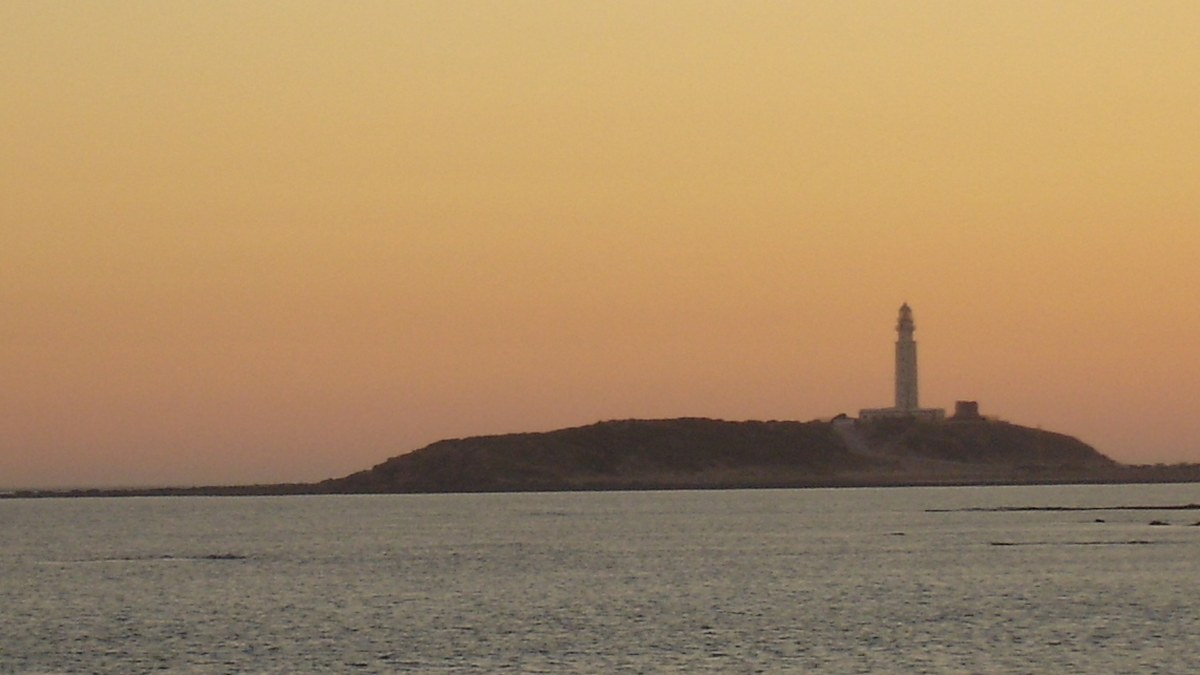
Cape Trafalgar is a name most people meet in a history textbook. On 21 October 1805, off this headland on the coast of Cádiz, Admiral Nelson's fleet destroyed the combined French and Spanish navies, and Nelson himself died aboard HMS *Victory*. The lighthouse that stands there now, first lit in 1862, keeps watch over the same water. It is a place defined, in the public imagination, by a single afternoon.
Under the sand at the cape's feet, though, there is an older story — older by some three and a half thousand years. A study published on 11 November 2026 in the journal *PLOS One* describes two stone tombs found beneath the dunes of the Trafalgar tombolo, in use between about 1875 and 1625 BCE. They held at least twenty people, buried generation after generation in the old collective way, at a time when most of southern Iberia had already given that way up. And they held gold, silver and ivory that had travelled a long way to get there. The paper's title ends with a question mark, and the question is the interesting part: were these people the last builders of megaliths in southern Iberia — or only the last whose tombs happened to survive?
A cist that was not a cist
The tombs were found the way so many finds are found now: because someone was looking for something else, and because a dune moved. A surface survey around the year 2000 had already noted a possible cist grave — a small stone-lined burial — almost buried under a dune on the tombolo, the strip of sand that joins the rocky headland to the mainland. Cape Trafalgar is unusual even as geography goes: it has a double tombolo, one to the east and one to the west, so the headland sits almost like an island tethered to the shore. It lies in the Strait of Gibraltar, about 44 kilometres from the African coast, inside the La Breña y Marismas del Barbate Natural Park.
In May 2021, a team from the University of Cádiz, led by Eduardo Vijande-Vila, cleared the supposed cist. It was not a cist. It was the beginning of a passage — the entrance corridor of a megalithic tomb, which the study calls Tomb I. A year later, in May 2022, a second tomb appeared about 180 metres to the southeast, after the team removed a dune roughly three metres high. The dunes, several metres deep in places, had made the tombs extremely difficult to locate. They had also done the tombs a favour: the same sand that hid them had protected them from looting.
The tombs were excavated in 2021 and 2022, recorded in detail with laser scanners and drones, and then buried again — reburied deliberately, to protect them, since the wind off the Strait would demand constant maintenance if they were left open. What visitors can see now, in exhibitions in Cádiz, Vejer de la Frontera and at the Dolmens of Antequera, are the digital models and resin replicas the team made instead. The real tombs are back under the sand.
Two tombs, two kinds of building
Tomb I is a hybrid. A passage just under 2.6 metres long, flanked by large upright slabs and roofed with capstones, leads into an oval chamber cut directly into the rock. The whole structure was covered by a mound of stones and sand about four metres across, and access was sealed at two points: a slab at the entrance and a stone wall in front of the chamber. It faces inland.
Tomb II is a different kind of building altogether: a *tholos*, a circular chamber tomb roofed with a false dome — a corbel vault, courses of stone stepping inward until they close at the top. Its chamber is about 2.9 metres across and looks out toward the sea. And it carries the scars of a long working life. At some point the original dome collapsed, and whoever was still using the tomb built a central pillar out of three slabs and filled half the chamber to hold the structure up. The usable floor shrank from 6.54 square metres to 2.65 — from about seventy square feet to less than twenty-nine. Over time, dune sand seeped in, and the roof eventually collapsed anyway.
Sixteen radiocarbon dates, taken from the bones of sixteen different people and run through Bayesian statistical models, give the tombs a clear sequence. The chambers were used first, around 1875 to 1700 BCE; then the passages, around 1740 to 1630 BCE, with a peak of activity around 1750 to 1700 BCE. Both tombs were in use at the same time for a little more than two centuries. One skull from the passage of Tomb I is clearly later, dating to 1610–1440 BCE, and the researchers read it as a one-off reuse — someone, centuries after the tombs' main life, opening the passage once more for a single burial.
To put that in company: around 1790 BCE, while these tombs were in use, Hammurabi ruled Babylon and had his laws carved in stone. In Egypt, the Middle Kingdom was in its final century. In Britain, Stonehenge's great sarsen phase was already centuries old. The people burying their dead at Trafalgar were not living in a remote backwater of prehistory; they were contemporaries of the first great law code, and they were still building with big stones.
Twenty people, and one woman apart
The human remains are highly fragmented and mixed, as they usually are in collective tombs used over generations. The dead were not laid out and left alone; these were secondary burials, meaning the bones were rearranged after the bodies had decomposed, to make room for the next generation. Anthropologists estimated the minimum number of individuals by counting the most frequently repeated bones. They found at least thirteen people in Tomb I and seven in Tomb II — men, women, a child and an adolescent among them.
Among all the dead, one person stands out. In Tomb I, a young adult woman was found still lying in her original position, her skeleton articulated — the only person in either tomb found that way. By the dates, she was the last burial placed in that chamber before it was sealed, and she was buried with grave goods that no one else had. We do not know her name, her age in years, or how she died. The study does not say, and there is no honest way to guess. What the bones do say is that she was treated differently at the end — laid down whole, with things of her own, and then the chamber was closed behind her.
There is a smaller, stranger detail in the bone chemistry. Analyses of the bones suggest the sea contributed little to these people's diet — curious for a community buried within sight of the water, on a headland in one of the great straits of the ancient world. They lived beside the sea, traded across it, and were buried facing it. They do not seem to have eaten much from it.
Gold, silver and an ivory comb
The grave goods are scarce but striking. Tomb I yielded two gold earrings, three silver beads, three beads of a green mineral and an ivory comb, plus two perforated shells. Tomb II had only one earring, one arsenical copper arrowhead and one green bead. A team led by Salvador Domínguez-Bella analysed the pieces with techniques that do not damage them, and almost none of the material came from the local area.
The gold is nearly 88 percent pure, with about 12 percent silver, and it resembles gold found at other Iberian sites such as Valencina de la Concepción. It is most likely Iberian, though an African origin cannot be ruled out. The silver could have come from the southeast, the territory of El Argar, or from the Iberian Pyrite Belt in the southwest — but the pieces are too small for the isotope analysis that would settle it. The green beads are made of a chromium-bearing mica, a sheet-like mineral that does not exist in the local geology; where it came from is unknown. The ivory comb is most likely African in origin, though the authors do not exclude Asia.
That matters because of what was happening around these people. In the southeast of Iberia, El Argar had consolidated into a strongly hierarchical society that consumed silver on a large scale at the same time. In Cádiz and Málaga, by contrast, silver appears rarely, and almost always as ornament. The authors read that contrast as a sign that elites in the southwest were weaker — or met more resistance to abandoning kinship ties, the old bonds of family and clan, in favour of hierarchy. It is an interpretation, not a proven fact, and the authors present it as such. But the objects themselves are facts: a small coastal community, burying its dead in the old way, had gold, silver and ivory in its tombs, and the materials had crossed water and mountains to reach them.
Built anew, or reused?
Here is the question the whole paper turns on. Around 2200 to 2100 BCE, megaliths in the southern Iberian Peninsula declined in size and number, while individual burials — stone-lined cists, single graves — increased. After that point, the usual practice was reuse: people kept burying their dead in dolmens and tholoi inherited from the Chalcolithic, the Copper Age, long after anyone had built a new one. At the Alcaide necropolis in Antequera, or at Los Algarbes in Tarifa, people continued to bury their dead well into the second millennium BCE, but in earlier tombs.
The Trafalgar team argues that their tombs may be different: not reused Chalcolithic monuments, but constructions of the Bronze Age itself, built from scratch around the nineteenth century BCE. Their evidence is the dates, the pottery — 687 fragments, undecorated, in forms typical of the Early Bronze Age — and the absence of older materials in the area. If they are right, Trafalgar would be one of the latest megalithic necropolises in Iberia, built at a time when almost no one was building them any more.
But the authors stress, repeatedly, that this is a hypothesis. The age of the bones only says when the tombs were used, not when they were built. To date the building itself, another technique will be needed: luminescence dating, which measures when sand or stone was last exposed to light. And there is an alternative that is not ruled out. Perhaps the chambers already existed, and were emptied of earlier remains — as has been proposed for Cerro Malhanito and Roça do Casal do Meio in Portugal, where such a cleaning would have erased the trace of the first use. An empty tomb leaves no evidence of having been emptied.
If the builders were the same people who used the tombs, the authors suggest that the persistence of collective burial in Cádiz could have been a form of resistance to new centralised political models — a community holding on to the old way of burying its dead together, generation after generation, while the world around it reorganised itself into hierarchies. They present that argument as a hypothesis too, given that the region lacks other evidence of state-like structures. It is a careful paper, and its care is part of what makes it worth reading: every bold claim arrives with its own qualification attached.
A broken dinnerware set
There is one more curious detail, and it is the kind of detail this column exists for. Not a single complete vessel was found in the tombs — only small fragments of pottery, concentrated mainly in the mound. The authors believe the breakage was intentional, linked to feasts or funerary rites, and they do not rule out that the living kept the missing fragments as reminders of the ceremony.
Think about that for a moment. A funeral feast on a headland above the Strait, three thousand eight hundred years ago. Pots broken on purpose, in the course of the rite. And the mourners walking away with a shard each — a piece of the same vessel, carried home, kept. The archaeologists found the fragments that were left behind. The fragments that were kept are gone, dispersed with the people who carried them, and they will never be found. It is a small, human image, and it survives only because someone thought to count the pieces and notice that none of them fit together into a whole.
The question mark
The tombs are back under the sand now, and more graves may be hidden in the dunes — although geophysical survey is difficult there, because dry sand conducts electricity very poorly. Analyses the team already has underway — ancient DNA, paleopathology, stable isotopes — should clarify how these people ate, how much they moved, and what kinship ties united them. For now, those answers are pending.
And the question in the paper's title remains open, which is exactly where the authors leave it: whether the people buried under the dunes of Trafalgar were truly the last to build megaliths in southern Iberia, or only the last for whom evidence has survived to us today. A first in archaeology is often a first in detection, not a first in history. There may have been other late megalith builders whose tombs were ploughed under, quarried away, or simply never found. Trafalgar survived because a dune covered it, and a dune is a matter of wind.
What stays with me is not the gold or the ivory, though both travelled farther than the people who wore them probably ever did. It is the ordinariness of the persistence: a small community, on a windy headland at the edge of the known world, burying its dead the way its grandparents had buried theirs, two centuries after the fashion had changed — breaking pots at the graveside, keeping a shard, sealing the chamber behind a young woman laid down whole, and then, in the end, letting the sand take the whole place back. They did not know they were the last of anything. They were only doing what they had always done. The dune kept the receipt.
Sources, in plain text: Vijande-Vila et al., PLOS One 21(11): e0359220, 11 November 2026; La Brújula Verde, 12 November 2026; PLOS One article page, background section. Corrections are welcome. If a source named here has been misread, or if a better source exists, write to the correspondence address on the contact page. A correction that changes the meaning of an entry will be noted in the entry itself. Whether the tombs were built in the Bronze Age or are reused older monuments is not established, the young woman's identity and cause of death are unknown, and the results of the ancient DNA and isotope analyses are not yet available.