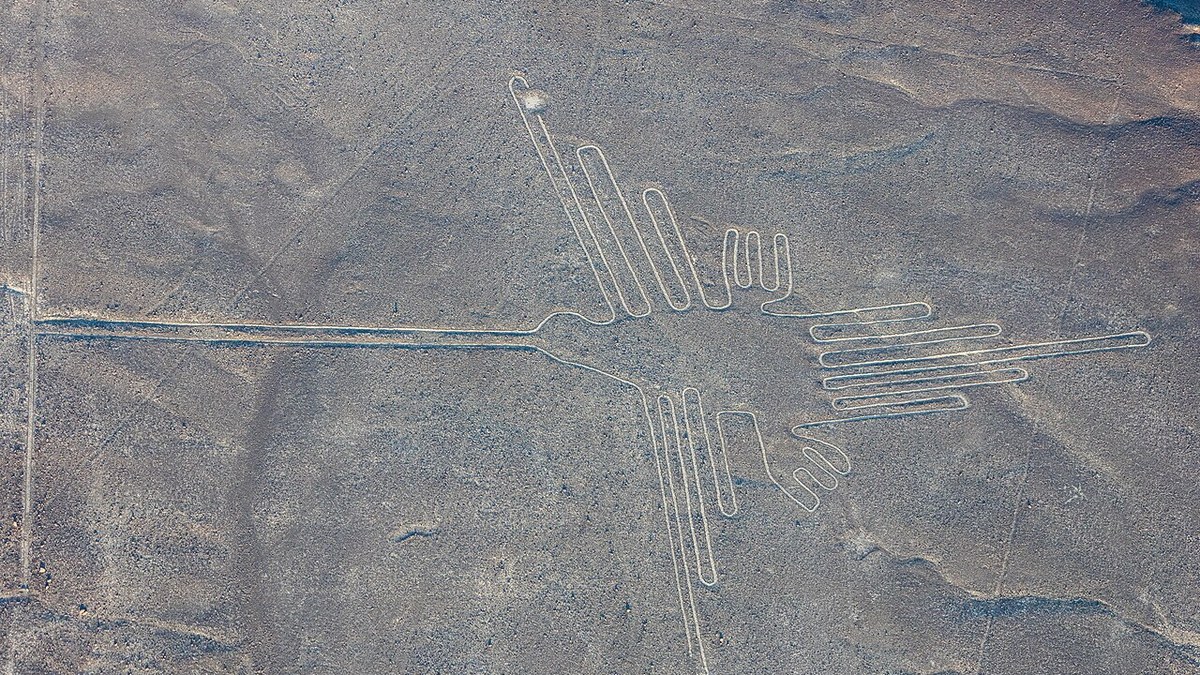
There is a valley in southern Peru where the desert keeps its dead in jars. The Palpa Valley is dry country, part of the same landscape that holds the Nazca Lines — the great ground drawings that have drawn travellers and theories for a century. But the valley's ordinary dead are quieter than its famous lines. In the Middle Nazca period, roughly AD 325 to 440, when a small child died in this valley, the family often laid the body in a ceramic urn and set the urn in the ground among the other graves. Dozens of such burials have been found at a site called Jauranga. Most of them tell the same short story: a child died young, and was buried the way children were buried.
One urn told a different story. It held two baby girls, one laid above the other. And the girl at the bottom had been born with a condition no archaeologist had ever found in a burial before: a single eye socket, set in the centre of her face.
The study describing her was published on 9 November 2026 in the *Proceedings of the National Academy of Sciences*. It is, by the account of an outside expert who was not involved in the work, the first archaeological example of this developmental condition ever identified. Physicians have known it for centuries. Anatomical collections hold specimens of it. But until this small grave in Peru, it had never been found in the ground.
What the bones showed
The infant is known in the study as JA13A. Her skull was very small, and where a face should carry two orbits — two sockets, left and right — hers carried one, a single median opening in the middle of the forehead. Other bones of the head were abnormal as well. Together, the features matched the clinical description of cyclopia: a condition in which the front of the developing brain fails to divide into two hemispheres, and the face follows the brain's lead, forming one central eye instead of two.
The name is old, and it comes from myth. Cyclopia takes its name from the Cyclops, the one-eyed giants of Greek story — Polyphemus, who held Odysseus prisoner in his cave, and the smith Cyclopes who forged thunderbolts for the gods. That is where the word comes from, and it is worth saying plainly what it is not: there is no evidence connecting this Peruvian child to Greek myth, and the people who buried her had never heard of Polyphemus. The link is in the name we gave the condition, centuries later, when physicians reached for a mythological word to describe a face with one eye. The burial itself belongs to the Nazca world, not to the Greek one, and it should be read on its own terms.
Cyclopia is rare. It occurs in about one in 100,000 births. The cause, the study's first author Elsa Tomasto-Cagigao explained, is present from conception, but the visible defect develops around the fourth or fifth week of pregnancy, at the point when the frontal region of the brain should separate into left and right. Most pregnancies involving cyclopia end in miscarriage. Among infants born alive, survival is usually brief.
The skull alone was strong evidence. But the team, led by Tomasto-Cagigao of the Pontifical Catholic University of Peru with anthropologist Lars Fehren-Schmitz of the University of California, Santa Cruz, wanted to know what had caused it — and for that they needed something far harder to recover from a 1,600-year-old infant: DNA.
What the DNA proved
From the infant's remains, the researchers extracted and sequenced her genome. It established two things. The first was that she was female: two X chromosomes. The second was that she carried an extra copy of chromosome 13 — a condition called trisomy 13, or Patau syndrome. Trisomy 13 is one of the principal known genetic causes of cyclopia, although only a small proportion of infants with trisomy 13 develop the defect.
The genetic evidence also settled a question the bones alone could not. The skull's unusual shape was not the result of intentional head modification — a practice known from ancient cultures, including Andean ones — nor had the bones simply been distorted after burial. The abnormality had its origins before birth. Whatever happened to this child happened in the womb, in the first weeks of her making, and nothing done to her afterwards explains it.
There is a third thing the DNA showed, and it concerns the other child in the urn. The two infants had different mothers. The second girl's genetic material was too poorly preserved for the researchers to establish whether the babies shared any other family relationship. Beyond the fact of different mothers, their connection remains unknown.
Two girls in one jar
At the bottom of the ceramic urn lay the infant with cyclopia. Directly above her were the remains of another baby girl, whose skeleton showed no apparent abnormalities. "Nevertheless, it appears that they were interred in a single event," Tomasto-Cagigao told *Live Science*. Burial in ceramic urns was customary for young children in the region, and the researchers found no indication that the grave had been reopened for a second burial. Both girls appear to have been placed there together.
That is a fact that invites speculation, and speculation is where the record stops. Two infants in one urn was not the custom. Were they buried together because they died at the same time? Because their families were linked in some way the bones cannot show? Because one death followed the other so closely that a single grave served for both? The study does not say, and neither should we. The two girls had different mothers; beyond that, their relationship is a blank, and the honest thing is to leave it blank.
What the grave did not contain is almost as telling as what it did. The urn stood in an ordinary cemetery, surrounded by other burials, with no special objects accompanying the two children. There was nothing in the grave to suggest an unusual ceremony. For Fehren-Schmitz, the absence of anything extraordinary was itself revealing. "It was neither 'excluded' because of it nor treated in a 'special' way," he told *Live Science*. Despite being born with a condition that would have made her appearance noticeably different, the little girl was buried much as other children in her community were buried.
That distinction matters. In ancient Andean societies, people with disabilities sometimes occupied particular social or religious roles — difference could mark a person out, for reverence or for suspicion. At Jauranga, the archaeologists found no evidence that this infant was either singled out for special treatment or denied an ordinary burial. She was put in the ground the way the other children were put in the ground, in the same kind of jar, in the same cemetery. "If that reflects Nasca society as a whole, we can't say based on one case," Fehren-Schmitz said, "but it does reflect the community this infant was part of, even if only briefly."
How long did she live?
One question remains particularly difficult to answer, and it is the one that stays with you after the science is done. How long did the baby live?
Fehren-Schmitz has said the researchers are confident she was born alive, although they cannot establish her exact lifespan. Given the severity of cyclopia, he considers it most likely that she survived only a short time. But Siân Halcrow, a bioarchaeologist at the University of Otago in New Zealand who was not involved in the research, noticed something in the study's estimated age at death: the figures leave open the possibility that the infant survived for several weeks or even months.
For a baby born with cyclopia, surviving that long would have required extraordinary attention. Someone would have needed to feed her, keep her warm, and protect her through a period when even basic survival would have been difficult. Whether that happened cannot yet be established. But the possibility changes how the burial might be understood. The child may have received more than a place among the dead. She may also have been cared for, day after day, while she was alive.
For Halcrow, the case raises a larger question about the care ancient communities gave to infants born with profound physical differences. The remains cannot tell us who held this baby, who fed her, or how her family responded to her condition. What they can tell us is that she was not hidden away. She was buried openly, in the common ground, beside another child, in the ordinary manner of her people.
A first, and what it is not
Cyclopia itself is no medical mystery. Physicians have described the condition for centuries, and specimens survive in anatomical collections around the world. What makes the Peruvian discovery exceptional is its archaeological setting. Until now, no excavated ancient burial had yielded a confirmed example. "This condition has been documented in historic and modern anatomical collections, but to my knowledge this is the first archaeological example of this developmental abnormality," Halcrow said.
It is worth being careful about what that first means. It does not mean that cyclopia never happened before this child, or that no other ancient infant was born with it. It means that this is the first time the condition has been confirmed in remains recovered from the ground, with the diagnosis supported by both the shape of the bones and the sequence of the genome. Other cases may have existed and gone unrecognised, their bones too fragmentary or too poorly preserved to read, or their graves never found. A first in archaeology is often a first in detection, not a first in history.
There is another caution to keep. The Nazca Lines lie in the same desert region as Jauranga, and it is tempting to join the two — a strange child, a strange landscape, a ready-made mystery. But there is no evidence in the new paper linking this child's condition to the geoglyphs, and none should be invented. The Lines are a wonder of the same culture and the same valleys. This burial is a small, human fact from the same valleys, and it needs no wonder attached to it to be worth remembering.
What stays with me is not the strangeness of the skull, though the skull is strange enough. It is the ordinariness of the grave. A child was born with a face that would have startled anyone who saw it, in a world without medicine that could explain it or surgery that could alter it. She was born alive. She may have lived days, or weeks, or months — long enough, perhaps, to be fed and held by people who knew exactly what she looked like. And when she died, they buried her as they buried their other children: in a jar, in the common ground, with another small girl laid gently above her. No special honours. No exclusion. No monument. Just a place among the dead, kept for sixteen centuries in the dry earth of the Palpa Valley, until a team of archaeologists opened the urn and found that one of its two small occupants had a story no burial had ever told before.
Sources, in plain text: Tomasto-Cagigao et al., Proceedings of the National Academy of Sciences, 9 November 2026; Kristina Killgrove, Live Science, 9 November 2026; The Daily Galaxy, 10 November 2026. Corrections are welcome. If a source named here has been misread, or if a better source exists, write to the correspondence address on the contact page. A correction that changes the meaning of an entry will be noted in the entry itself. The infant's exact lifespan is unknown, the reason the two infants shared one urn is not established, and there is no evidence linking this burial to the Nazca Lines.