There is a housing estate going up at 134–148 rue de Verdun, in Champigny-sur-Marne, about twelve and a half kilometres east of the centre of Paris. Before the builders could start, French law required someone to look underneath. That is how preventive archaeology works in France: a plot is earmarked for development, the regional archaeology service asks the National Institute for Preventive Archaeological Research — Inrap — to investigate, and only then do the diggers move in. Most of the time, Inrap finds what it expects to find: a few postholes, a ditch, a scatter of pottery. This time, under a perfectly ordinary street in a perfectly ordinary suburb, the archaeologists found a cemetery that should not have been there, guarded by a stone giant lying flat on its back.
The cemetery is about six and a half thousand years old. The archaeologists date its main phase to the Middle Neolithic, between about 4750 and 4300 BCE — a time when farming communities were putting down roots along the river valleys of northern France, when the Marne was a working river and Paris was not yet even a rumour. What they found on the upper part of a terrace formed by the Marne was eleven graves and thirty megalithic stone blocks: a funerary complex of a scale and ambition that the Paris basin was not supposed to contain. In the Île-de-France region, burials from this period are usually found in isolation — a grave here, a grave there, alone in the ground. A cemetery, with monuments, is something else entirely. It means somebody chose this ground, and kept choosing it, and built things on it that were meant to last.
A stone with a belt
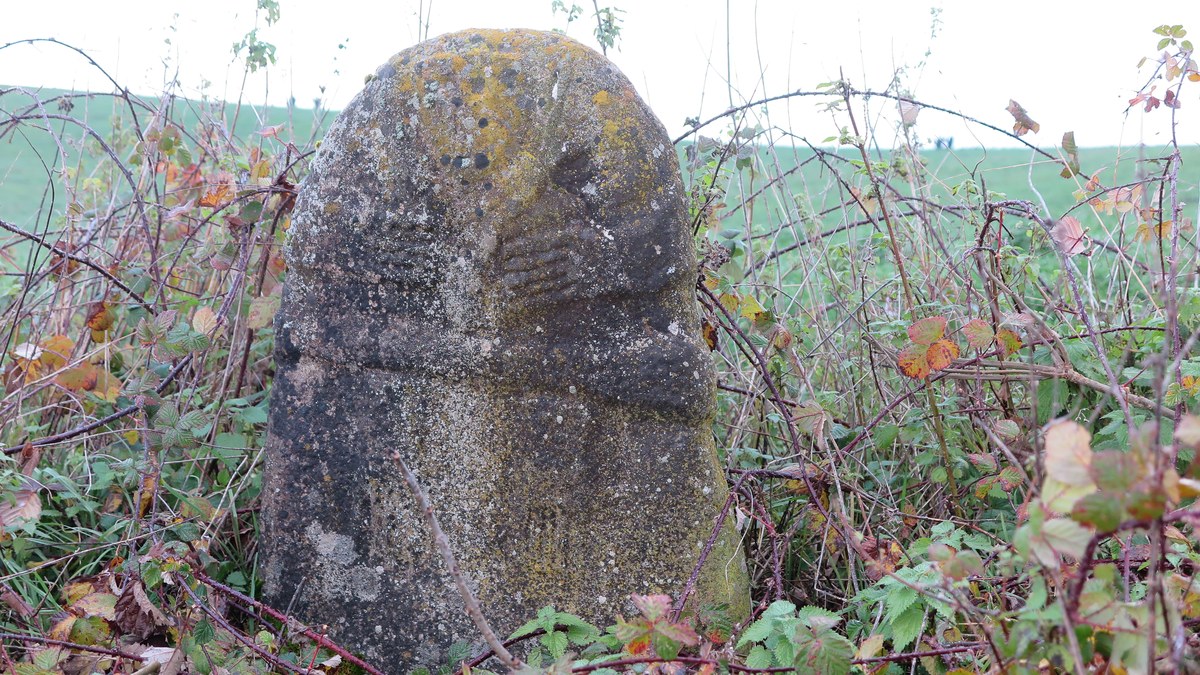
The centrepiece is the stone itself. It is a statue-menhir — a standing stone carved with human features — and it is enormous: 3.04 metres long, 1.68 metres wide, 0.74 metres thick, weighing an estimated 9.7 tonnes. That is roughly the weight of two adult elephants, in a single slab of stone. It was found lying flat inside a clearly identifiable setting pit, the hole that had once held it upright. Inrap reads its position as a snapshot of abandonment after the monument's collapse, although what made it fall is not known. It had stood more than ten feet tall.
Look closely at the stone, and it stops being a slab. Its surface carries an engraved belt, and a series of cupules — small circular depressions deliberately cut into the rock. The researchers also noted traces of what may be black and white pigments, raising the possibility that the monolith was once brightly decorated: a painted figure, ten feet tall, standing over the dead. That is a possibility, not a certainty — the pigment traces are described as potential, and I will not upgrade them into a fact. But even without paint, the carving is the point. Someone took a nine-ton stone and gave it a belt. Someone decided that this stone was a person, or stood for a person, and dressed it accordingly.
It was not alone. Two smaller sandstone monuments stood nearby, including a miniature menhir that may have served as a territorial marker — a small stone doing the same work as the large one, at a different scale. Around the great stone, three graves had been placed. They had been disturbed by modern construction, which is the usual fate of ancient things found under modern streets: the builders got there first, centuries later, and did not know what they were cutting through.
The strangeness of the find is partly a matter of geography. The carved statue-menhirs of France are most famously associated with the south — the Rouergue, in what is now Aveyron, has produced the great corpus of them, human-shaped stones with belts and faces and weapons carved in shallow relief. Finding one beside the Marne, east of Paris, is what makes Champigny odd. The Paris basin has its own megalithic monuments — the Pierre Turquaise at Saint-Martin-du-Tertre, some thirty-five kilometres north of Paris, is a Neolithic covered alley described as the largest megalithic monument in the Île-de-France — but a carved human-shaped giant, ten feet tall, is a southern kind of object in a northern place. Either the idea travelled further north than anyone had documented, or the people of the Marne valley had their own version of it, and this is the first time we have caught them at it. The sources do not settle that question. It is worth sitting with it, rather than solving it.
The man who sat down in his grave
Eleven graves, and ten of them behave more or less as graves should. Most of the dead were laid out in an extended position, on their backs, and a posthole was found near each head — probably a marker, a small wooden post standing over the grave so the living could find it again. The grave goods are modest and practical: flint tools, projectile points, an axe of local sandstone. These are the things of a farming community that hunted as well as it farmed, and buried its dead with the tools of the life they had lived.
The eleventh grave does none of this. In it, an adult was buried in a seated position, inside a narrow, circular pit — a well-like grave, upright rather than laid out. And the lower extremities of the body were encased in a thick layer of calcite. That is the detail I keep coming back to. Calcite forms when mineral-rich water deposits calcium carbonate, slowly, over time; here it had built up around the legs of a seated corpse until it held them like a cast. Inrap has not established why this individual was buried differently from the others, and the reporting is careful to say so. The reason for the seated position remains unknown, and neither the posture nor the shape of the grave is enough to establish the person's identity, social standing, or the beliefs behind the burial. I will not guess. But the oddness is real, and it is the kind of oddness this site trades in: a community that buried ten of its dead one way, and one of its dead in a way nobody can yet explain.
There is a temptation, with a grave like this, to invent a story — a chief, a priest, an outcast, a punishment. The sources offer none of those. What they offer is a body, seated, in a round pit, with stone growing around its legs, in a cemetery that already had a ten-ton carved guardian. That is enough to work with. Sometimes the odd page of history is not a story with a missing ending. It is a scene with no caption at all.
Cement, six thousand years early
If the statue-menhir is the most spectacular thing at Champigny, the most quietly startling may be the building material. The archaeologists identified a hardened substance made by combining locally available carbonate-rich sand and silt with gravel and water — a mixture that hardened as it dried. They used it to reinforce the boundaries of the graves and to support the massive megalithic structures. BioScience's account calls it a "primitive cement"; Arkeonews describes it as a sophisticated, early form of mortar. Similar construction techniques have been observed in Mediterranean Neolithic settlements, which makes seeing the technology applied to a funerary complex in the Paris basin highly significant. The people of Champigny were not only moving nine-ton stones. They were making the stuff that held them up.
There is a second structure on the site that plays the same kind of trick. The team identified a 30-square-metre earthen mound, built from brown silt, which looks for all the world like a barrow — a burial mound. It is not one. Excavation revealed no human remains inside it at all. Instead it contains structural elements: palisade trenches and postholes, suggesting it functioned as a symbolic or landscape-defining feature rather than a tomb. A mound with no body in it, built to look like a mound with a body in it. That is a deliberate piece of theatre, and it is one of the things that makes Champigny feel less like a cemetery that grew by accident and more like a place that was designed — a landscape of stones, mounds, posts, and graves, laid out on a terrace above the Marne with a purpose that we can see in outline but cannot yet read in full.
What Champigny does not fit
The archaeologists have a name for the puzzle. The discovery aligns chronologically with the Cerny culture cemeteries found in the Seine and Yonne valleys — the same period, the same broad region, the same world of Middle Neolithic farming communities. But it does not fit neatly into known cultural classifications. That sentence is doing a lot of work. It means the site is familiar enough to date and strange enough to resist labelling. A cemetery of this scale, with this combination of a carved giant, a seated burial, early mortar, and an empty mound, has no exact parallel in the Paris basin. It is a local variation on a theme, or a theme we had not known existed.
That is also why the work is not finished. The team is now moving into laboratory analysis. Ancient DNA testing and isotopic studies of the remains are expected to reveal new information about the diet, health, and ancestral origins of this Neolithic community — where these people came from, what they ate, whether they were locals or newcomers, and how this site functioned within the wider landscape of prehistoric France. Those answers will take months, and some of them may never come. DNA is not a story; it is a set of measurements. But measurements, laid alongside a ten-ton stone with a belt, can start to add up to a people.
There is something else worth saying about how this cemetery was found, because it is the least romantic part of the story and the most important. Champigny-sur-Marne was not found by a scholar with a theory, or a farmer with a plough, or a treasure hunter with a map. It was found because a housing development was planned, and the law said someone had to look first. The three graves around the menhir were disturbed. The giant itself survived because it was lying flat in its pit, below the level of the builders' disturbance, waiting out the centuries in the dark. That is the quiet moral of preventive archaeology: the past survives under our streets by luck as much as by law, and every new housing estate is a roll of the dice over ground that has been lived on for six thousand years.
The stone giant of Champigny stood over the dead for something like a thousand years, and then it fell, and then the ground forgot it, and then a suburb grew over it, and then the law required someone to look. What they found was a cemetery that the Paris basin was not supposed to have, a carved stone that belonged further south, a seated burial nobody can explain, a mound with nothing in it, and a recipe for cement six thousand years before cement had a name. None of it fits neatly. That is exactly why it belongs on the odd page.
Sources, in plain text: Archaeology Magazine, 5 November 2026; Arkeonews, 3 November 2026; BioScience, 8 November 2026; EuropeSays, 7 November 2026; Ancientist, 3 November 2026; Wikipedia, 'Champigny-sur-Marne'; Paris Select, 8 February 2026. Corrections are welcome. If a source named here has been misread, or if a better source exists, write to the correspondence address on the contact page. A correction that changes the meaning of an entry will be noted in the entry itself. Why the seated individual was buried sitting down is unknown, whether the menhir was painted is only a possibility, and the results of the planned ancient DNA and isotopic studies are not yet available.