There is a particular kind of silence that only a shut cupboard can keep. A room can be emptied, a house can be abandoned, a whole city can be buried — and still, somewhere inside it, a door that nobody opened will hold its contents exactly where they were left. On 29 October 2026, the Archaeological Park of Pompeii published the excavation of such a cupboard: a wooden wardrobe in a house on the Via dell'Abbondanza, full of the small, ordinary things of a life — tweezers, a perfume bottle, a bronze lamp, thirty-eight coins in a little basket — and, tucked among them in a cloth bag, a necklace of at least twenty-four tiny charms, made for a child. Nobody had touched any of it since the year 79.
The wardrobe itself is gone. Wood does not survive two thousand years under volcanic ash, and the archaeologists are the first to say so. What they found was the space the wardrobe had occupied: a cavity in the compacted deposit, post holes in the walls, and the objects that had fallen from its upper shelves when the roof came down. It stood in the south-east corner of a room the excavators call Room B, in two sections, one along the south wall and one along the east. The house is numbered IX 11, 7, and it is known — tentatively — as the House of Cornelius Maximus. Its facade was first excavated in 1912, and the name comes from inscriptions that were once visible on that facade and are no longer legible. The authors of the report call the attribution highly doubtful, which is the honest way of saying that the house has a name and the people who lived in it do not.
A street, a house, a renovation
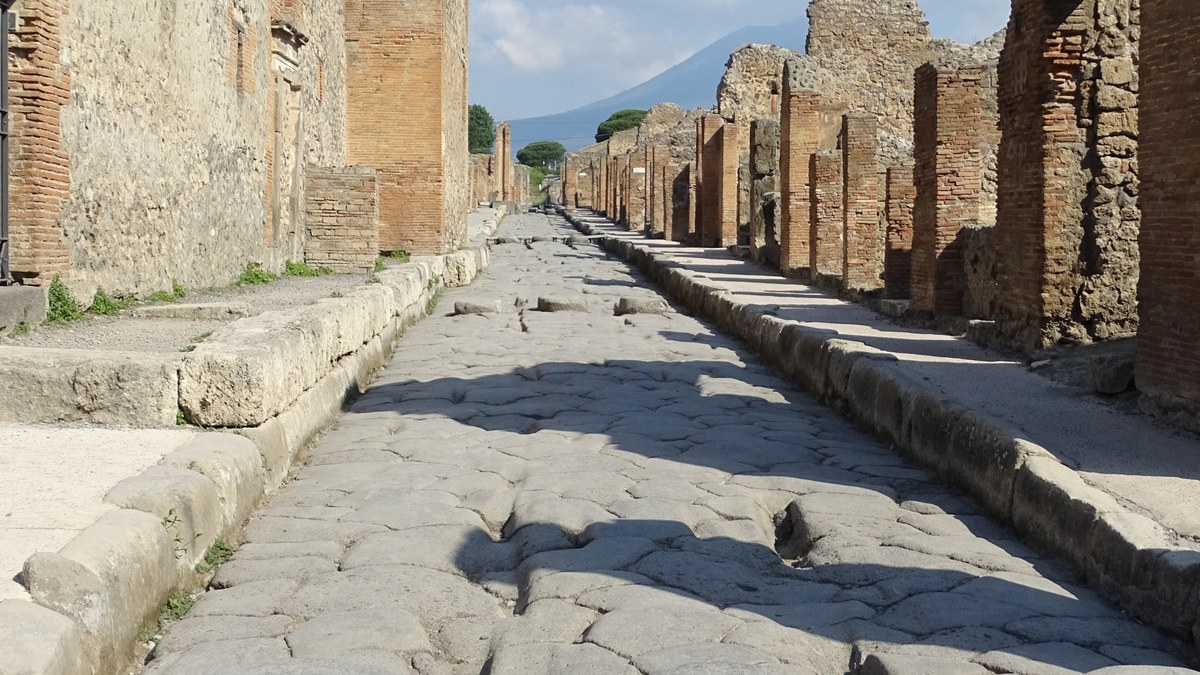
The house faces the Via dell'Abbondanza, one of the busiest streets in Pompeii — the city's main east-west thoroughfare, lined with shops selling bread, wine, oil and prepared food. The building sits beside the Insula of the Chaste Lovers, a city block that has been the focus of a major restoration project since 2024, and the wardrobe excavation belongs to that project. The frescoes in the house's rooms are in the fourth style of Roman wall painting, the style that was popular between about 20 and 79, which fits the date of the eruption the way a frame fits a picture.
There is one more detail about the house, and it matters, because it changes the shape of the story. The archaeological evidence suggests the building was under renovation when Vesuvius erupted. The researchers do not know whether that work had anything to do with what happened to the people who lived there. If they stayed in the area while waiting for the work to finish, they may have been caught by the pyroclastic flows and the toxic gas. Or they may have got out of the city and simply never been able to come back. Either way, the wardrobe stayed shut, and the life inside it stayed where it had been put.
That is the first thing that strikes me about this find: it is not a treasure in the usual sense. Nobody hid this wardrobe. Nobody sealed it deliberately, the way you might seal a tomb. Someone put their things away in a cupboard — the ordinary, end-of-the-day act of putting things away — and then the world ended, or at least their part of it did, and the cupboard did the rest. The ash did not choose what to preserve. It preserved whatever happened to be shut inside.
What was in the cupboard
The contents read like an inventory of a household, taken by someone who did not know they were taking an inventory. A pair of tweezers. A mortar used for preparing makeup pigments. A glass balsamarium, the small flask that once held perfume or scented oils. A bronze oil lamp. An incense burner. Ceramic vessels for cooking and dining: a two-handled cup, six lids of varying diameters, an assortment of pots. A wooden box filled with eight lead weights, which the excavators think may have belonged to a merchant balancing scales during commercial transactions. And thirty-eight bronze coins, kept in a small woven basket called a cistella, most of them dating to the reign of the emperor Nero, who ruled from 54 to 68.
Several of these objects belong to what Roman historians call the *mundus muliebris* — the things intended for the personal care and adornment of women. That is why some of the press coverage has called this "a woman's wardrobe," and it is worth pausing on the label, because the report itself does not earn it. The objects suggest a woman lived in the house, or at least that women's things were kept in this cupboard. They do not identify her. "We cannot reconstruct with certainty the identity of whoever lived in the house," the park's director, Gabriel Zuchtriegel, said in a statement, "but these fragments bring us closer to their daily life." The value of the discovery, he added, "lies in the possibility of reading together the different traces of a life: personal habits, work and memories." That is the careful version, and it is the right one. A cupboard full of women's things is not the same as a named woman, and the gap between the two is where the history actually lives.
There is one more thing in the cupboard that deserves its own paragraph, because it is also the oddest: the house had mice. Tucked inside an amphora, the excavators identified 117 bone fragments that likely belonged to field mice. A rodent problem, much like the one found at the nearby villa of Civita Giuliana. It is the kind of detail that no one would invent and no one would put in a museum label, and it is exactly the kind of detail that makes a house feel inhabited. The grand houses of Pompeii have frescoes and fountains; this one also had mice in the pantry.
The necklace
But the find that has carried this story out of the excavation journal and into the newspapers is the necklace. At least twenty-four miniature objects, each pierced for suspension, made of faience — fine tin-glazed pottery — bone, glass paste and rock crystal. They depict deities, among them the Roman god Mercury and the Egyptian god Bes, alongside hands, feet, pine cones and bunches of grapes. They were found together, in a cloth bag, near the middle of the wardrobe's south arm.
These are *crepundia*. The word comes from the Latin *crepare*, to rattle, and that is literally what they did: a necklace of small hard objects, worn by a child, that made a sound when the child moved. Roman parents gave them to their children for two reasons at once. The charms were protective, each one chosen to carry a meaning or a blessing. And they were practical: a child wearing a rattling necklace could be heard, and a child wearing a distinctive set of charms could be identified if it wandered off. In the ancient play *Rudens*, by the Roman dramatist Plautus, a *crepundium* worn by a young woman named Palaestra is what allows another character to recognise her as his long-lost daughter. The charm is the proof of identity. The necklace is the document.
Scholars used to take objects like these for magical tools, the equipment of spells and potions. The report is clear that they are not that — or not only that. They are children's things, worn in childhood, and the striking thing about this particular set is that it was kept. "What's striking is that while the single objects are not unusual in Pompeii, this particular group of objects is rather individual," Zuchtriegel told *Discover* magazine. A single amulet is common. Twenty-four of them, kept together in a bag in a cupboard, is a collection with a history behind it.
Whose history, exactly, is the question the report leaves open, and it leaves it open in a way that is worth respecting. The necklace may have belonged to a child who lived in the household. Or it may have belonged to an adult who received it in childhood and kept it as a treasured keepsake into adult life. "It was a reminder of their parents who perhaps lived far away," Zuchtriegel told the *Guardian*. "It was very typical of this society of people, who were often displaced. Many people moved around in the Mediterranean area and tended to carry personal objects with them." A child's necklace, carried into adulthood by someone who had left home: that is a small, portable piece of a family, kept in a cupboard in a house that was being renovated on the busiest street in Pompeii.
I keep coming back to the bag. The necklace was not displayed. It was not hanging on a hook, or laid out on a table, or worn. It was in a cloth bag, inside a cupboard. Somebody put it away. That is a different act from losing it, and a different act from wearing it. Putting something in a bag and putting the bag in a cupboard is what you do with a thing you intend to keep but do not need at the moment — a keepsake, a spare, a memory with a practical use still attached to it. It is the kind of small decision that never makes it into a history book, and it is the kind of decision this excavation has recovered whole.
The closet with no equal
"There's no other closet exactly like this one," Zuchtriegel told *Discover*. He means it literally: the combination of objects, the completeness of the assemblage, the fact that the contents were found together, in place, undisturbed since 79. Pompeii is often described as a treasure chest — Zuchtriegel himself has used the phrase — but he has also said that the description misses the point. "Pompeii means leaving the comfort zone of archaeology," he told *Discover*. "It's often considered a treasure chest because of the artworks, objects and architecture the volcano has preserved, and that's true in a way, but then there's so much more."
The "so much more" is the point of this wardrobe, and it is why the find belongs on an odd page of history rather than in a catalogue of antiquities. The great discoveries at Pompeii are usually about art, or architecture, or the violence of the eruption. This one is about a household. About tweezers and a perfume bottle and a box of lead weights. About mice in an amphora and thirty-eight coins in a basket. About a necklace that rattled when a child moved, kept in a bag, in a cupboard, in a house under renovation, on a street full of shops — until the day the people who owned it did not come back for it.
We do not know their names. We do not know whether they survived. We do not know whether the necklace belonged to a child in the house or to a grown person remembering one. What we know is that someone put their life away in a cupboard, neatly, in the ordinary way, and that the cupboard kept it. Nearly two thousand years later, the wood is gone, the house is a ruin, and the things are still there, in the order they were left. The cupboard stayed shut. The silence held. And when it was finally opened, what came out was not treasure. It was a life, in small pieces, waiting to be read together.
Sources, in plain text: Smithsonian Magazine, 6 November 2026; Archaeology Magazine, 29 October 2026; Zuchtriegel et al., E-Journal degli Scavi di Pompei, issue 11, 29 October 2026. Corrections are welcome. If a source named here has been misread, or if a better source exists, write to the correspondence address on the contact page. A correction that changes the meaning of an entry will be noted in the entry itself. The identity of whoever lived in the house is not established, whether the necklace belonged to a child in the household or to an adult keeping a childhood keepsake is unresolved, and whether the occupants survived the eruption is unknown.