There is a particular kind of luck that belongs to small things. A great gold hoard gets noticed. A great gold hoard gets looted, melted, scattered, and argued over for centuries. But a small thing — a bear no bigger than a thumbnail, cast in gold and sewn onto a piece of cloth — can slip past the looters, past the centuries, past the bulldozers of a modern city, and come out of the ground with its story still attached. That is what happened this week in Almaty, Kazakhstan, where archaeologists working a burial mound in a city district found a gold bear that nobody had found before, in a grave that had already been robbed.
The mound is called Karagaily. It stands in the Nauryzbay district of Almaty, the largest city in Kazakhstan, at the foot of the mountains that separate the Kazakh steppe from the high country to the south. It is not a remote place. It is a mound in a city, which is why the excavation was an emergency one: the archaeologists of the Almaty Museum Association were working against the clock, and against the city, to get the mound dug before it was lost. The mound measures about twenty-five to twenty-six metres across and stands about two and a half metres high — modest, by the standards of the great royal kurgans of the steppe, and easy to miss if you did not know what you were looking at.
The preliminary dating puts Karagaily in the fourth to third centuries BCE, in the period of the Saka cultures of Central Asia. The Saka were the nomadic peoples of the eastern steppe — the name Persian sources gave to the peoples the Greeks called Scythians — horse riders, herders, and goldsmiths, who buried their dead under mounds of earth and stone and filled those mounds with the things the dead would need. What they did better than almost anyone else in the ancient world was work gold into the shapes of animals: deer, ibex, leopards, griffins, horses with wings. The animals were not decoration. They were a language — of rank, of protection, of the world as the Saka understood it — stitched and hammered into the clothing of the people who wore them.
A mound that had already been robbed
The looters got to Karagaily first. That is the first fact of the story, and it shapes everything else. The burial had been robbed in antiquity: the excavators found a looters' pit driven about three metres down into the mound, and human remains and fragments of Saka pottery scattered through the disturbed earth. Whatever the mound had held in the way of treasure — and a mound of this size, in this period, would have held a great deal — most of it is gone, taken by people who dug in the dark and left the rest broken.
But the looters missed something. That is the second fact, and it is the one that matters. Among the disturbed earth and the broken pottery, the archaeologists found a small cast-gold ornament in the shape of a bear. It is pierced with small holes, the kind of perforations made so that a piece of gold can be sewn onto fabric. The researchers' reading of it is straightforward: the bear was sewn onto cloth, and the cloth was part of a ceremonial headdress. A bear, in gold, worn on the head.
"The sculptural bear figurine is unique to Kazakhstan. No similar discoveries have been made here before," said Lyazzat Sagyndykova, the director of the Almaty Museum Association. That is a strong claim, and it is worth taking seriously, because Kazakhstan is not short of Saka gold. It is the country of the Golden Man. But a gold bear, made to be sewn onto a headdress, is a thing the archaeologists of Kazakhstan say they have not seen before.
There is a third thing the looters left behind, and it is stranger than the bear. The mound appears to have held the remains of more than one person. The researchers believe it may have contained four adults and three children — seven people in a single mound. That number is still provisional; the anthropological analysis has not been completed, and the count could change. But if it holds, it is unusual. "Of particular interest is the unusually large number of human remains found within a single burial mound," said Marat Nurpeisov, a senior researcher at the Almaty Museum Association. "Such collective burials are uncommon in Kazakhstan. Typically, burial mounds of comparable size were intended for one or two individuals."
Seven people in a mound built for one or two. That is the odd page of this story, and it is the part that will take the longest to understand. Were they a family? Were they buried together, or one after another, the mound opened and closed again? Did they die together, or did the mound accumulate its dead over years? The bones will have to answer, and bones answer slowly. The anthropological analysis is still to come, and the archaeologists are careful to say so. For now, the seven are a count, not a story — and the count itself is the mystery.
The company the bear keeps
A single gold animal, on its own, can be hard to read. The Saka made thousands of them, and the meaning of any one piece depends on the company it keeps. The bear of Karagaily keeps good company, and the comparisons the archaeologists have drawn are the ones that make the find legible.
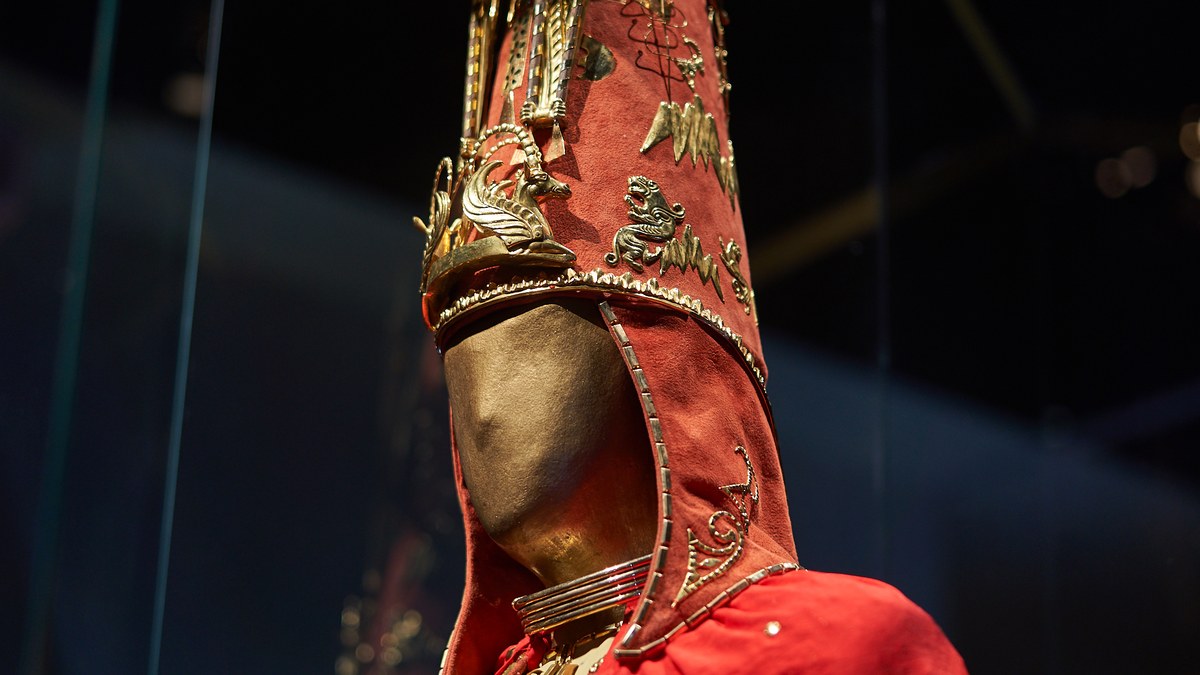
The most famous comparison is the Golden Man of Issyk. In 1969, archaeologists led by Kemal Akishev excavated a kurgan near the town of Issyk, about fifty kilometres east of Almaty, and found a young person — sixteen to eighteen years old, sex never determined — buried with more than four thousand pieces of gold. The gold had been sewn onto clothing and onto a tall conical headdress some seventy centimetres high, decorated with plaques of winged horses, leopards, mountain goats, birds, and trees. The Golden Man became a national symbol of Kazakhstan; a figure of him crowns the Independence Monument in Almaty's central square. Among the gold of Issyk was a gold ibex, an animal-shaped ornament of exactly the kind the Karagaily bear appears to be: a creature in gold, made to be sewn onto something worn.
There is a closer comparison still, and a more recent one. In 2014, at the Kok-Kainar burial ground, archaeologists found a small leopard figurine, also interpreted as a headdress ornament. The bear of Karagaily now joins a small and specific family of objects: animals in gold, made small, pierced for sewing, and worn on the head. The ibex of Issyk, the leopard of Kok-Kainar, and now the bear of Karagaily. Three animals, three headdresses, three mounds — and the bear, the archaeologists say, is the first of its kind.
The bear also raises a question that reaches beyond Kazakhstan. Sagyndykova has suggested that the ornament could provide evidence for wider cultural connections stretching across Eurasia, from the Black Sea region to the Altai Mountains. That is the scale on which the Saka lived: not a single tribe in a single valley, but a world of nomadic peoples spread across thousands of kilometres of steppe, sharing a visual language of animals in gold, trading, raiding, marrying, and burying their dead in the same way from the Danube to the Altai. A bear sewn onto a hat in Almaty is a local find with a continental address.
What the bear does not say
It is worth being precise about what we do not know, because the story is still young — the find was reported on 6 November, and the excavation is continuing. We do not know who wore the headdress, or whether the bear belonged to one of the seven people in the mound or to someone else entirely. The mound was looted, and looting scrambles the evidence: things move, things break, things that belonged together end up apart. The researchers propose that the bear decorated a ceremonial headdress; they do not claim to have found the headdress itself, or the cloth it was sewn onto. Cloth rots. Gold does not. What survives is the ornament, and the holes in it, and the reasonable inference that it was sewn onto something.
We do not know what the bear meant. The Saka made animals in gold for reasons we can only partly recover. The bear might have been a clan emblem, a protective charm, a mark of rank, or simply an animal the wearer admired. The sources do not say, and I will not invent an answer. What can be said is that animal-style imagery was central to Saka material culture, that it appeared on jewellery, clothing, and ceremonial objects, and that the choice of animal was never random. A bear is a strong animal, a solitary one, and a dangerous one. That is as far as the evidence goes, and the evidence is enough.
We do not know how the seven people died, or why they were buried together, or whether they were buried at the same time. We do not know the mound's exact date within the fourth to third centuries BCE — the dating is preliminary. We do not know what else the looters took, or when they took it, or whether the bear survived because it was hidden, or dropped, or simply overlooked in the dark at the bottom of a three-metre pit. A small thing, sewn to cloth, in a mound full of earth: it would be easy to miss. Perhaps that is the whole explanation. Perhaps the bear was lucky. Perhaps the looters were careless. Perhaps both.
What we do know is where the bear is going. After conservation and study, the most significant artefacts from Karagaily — the bear among them — are expected to enter the permanent collection of the Almaty Museum, and eventually to go on public display. That is the proper ending for a small gold animal that survived a robbery, a city, and two thousand three hundred years in the ground: not in a private collection, and not melted down, but in a museum in the city where it was found, where anyone can stand in front of it and wonder about the person who wore a bear on their head.
There is a lesson in the Karagaily bear, and it is the lesson this site keeps returning to. History is not only written by the great mounds and the great hoards. Sometimes it is written by the thing the looters missed — a bear the size of a thumbnail, with holes in it for thread, sewn onto a hat that rotted away centuries ago, in a grave that held seven people when it should have held one or two. The big questions of the Saka world — who they were, how far their world reached, what their animals meant — are not going to be answered by this one small bear. But the bear adds a word to the language. And in a language made of animals in gold, one new word is a great deal.
Sources, in plain text: Heritage Daily, 6 November 2026, citing KazinForm; Wikipedia, 'Issyk kurgan'; Wikipedia, 'Issyk Golden Cataphract Warrior'; ECIECO, 'The Golden Man: The Splendor of Civilization and Kazakhstan's National Identity'. Corrections are welcome. If a source named here has been misread, or if a better source exists, write to the correspondence address on the contact page. A correction that changes the meaning of an entry will be noted in the entry itself. The number of people buried in the mound is provisional, the identity of the wearer is unknown, and the bear's size and weight were not reported.