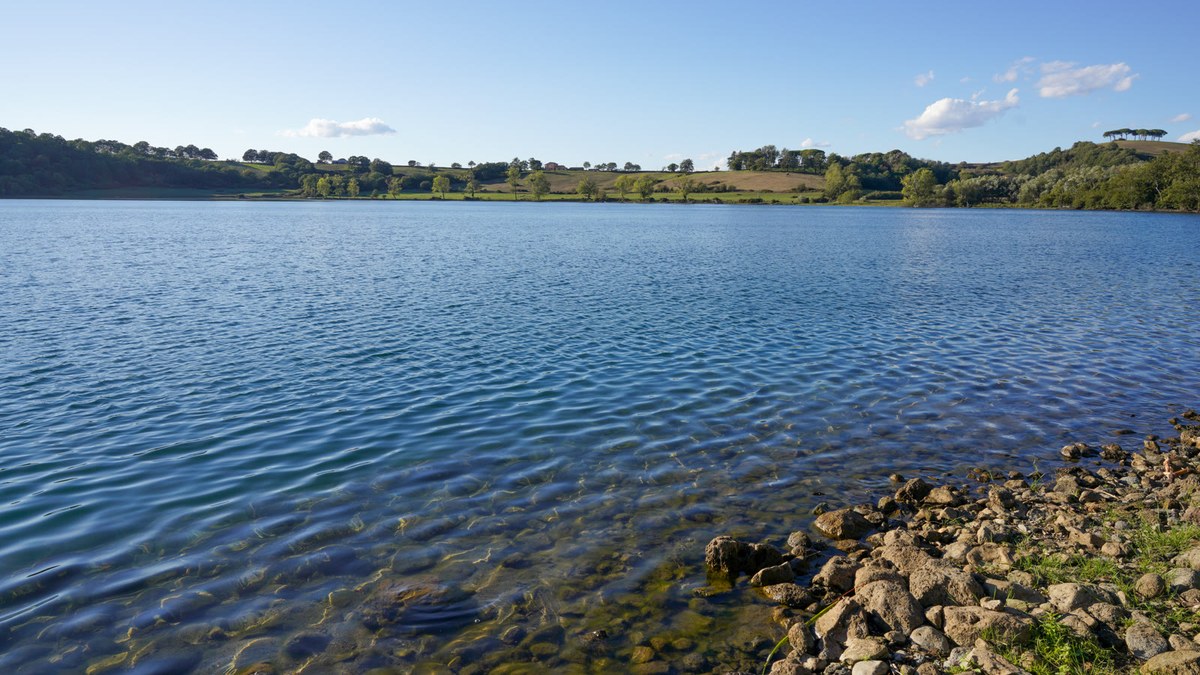
There is a small lake in central Italy, about sixty miles northwest of Rome, that fills the crater of a dead volcano. From the shore it looks unremarkable — a round sheet of water, half a square kilometre, ringed by low hills. Nothing about it suggests a village. Nothing about it suggests a sword. But in the last week of September, underwater archaeologists working along its southern shore pulled a bronze blade out of the mud, and the blade was still sharp enough to cut.
The sword is about 3,300 years old. It dates to the 13th century BCE, the Late Bronze Age, roughly five centuries before Rome was traditionally founded. It is the third sword to come out of Lake Mezzano since the 1970s, and the first to be found in more than fifty years. It was announced by Italy's Soprintendenza Archeologia, Belle Arti e Paesaggio for the province of Viterbo and Southern Etruria — the heritage authority responsible for the site — in early October, and reported in English in the first week of November. The announcement itself is spare. The story underneath it is not.
A village that stood on water
Lake Mezzano fills a crater inside the Latera caldera, in the municipality of Valentano, in the Tuscia region of northern Lazio. The lake is small — its surface covers about half a square kilometre, its greatest depth about 38 metres — but what lies beneath it is extensive. Between about 1700 and 1150 BCE, a Bronze Age community lived here, in a pile-dwelling village: houses built on wooden posts driven into the lakebed, standing over the shallow water at the lake's edge.
The village was discovered in 1971 by Lamberto Ferri Ricchi, a geologist who had been diving in the lakes of central Italy to test his own theory about how ancient settlements ended up underwater. He found the remains of three prehistoric pile-dwellings, submerged between nine and thirty feet deep. He returned a few years later at the request of the regional archaeology authorities and recovered about fifty vases, three bronze axes, skeletal remains, wooden planks, millstones, and other artefacts. The first two swords from the lake came out of this early work, sometime in the 1970s.
Then, for a long while, almost nothing happened. Excavations continued into the mid-1990s and then stopped, for nearly three decades, until funding became available again. That is the part of the story that does not make the headlines: a site of this importance, sitting in the dark for thirty years, not because it had been forgotten but because nobody could pay to look at it.
The work resumed in 2025. In the first renewed campaign, archaeologists mapped more than 600 wooden posts protruding from the clay lakebed, at depths from about eight feet to more than thirty-two feet. The posts are believed to represent roughly a third of the whole settlement — the rest is still down there, unmapped. The village, it seems, shifted as the water rose and fell over six centuries, its houses following the shoreline the way a camp follows a river. The 2025 season also recovered more than twenty-five bronze objects — winged axes, spearheads, brooches, rings, a pin, a sickle — and fragments of bronze ingots, which suggest the villagers were casting their own metal on site. They were not a remote outpost. They were makers, and traders: at this date, the people of central Italy maintained connections with communities throughout the peninsula and across the Mediterranean.
The third sword
The new sword was found on 28 September 2026, along the lake's southern shore, in a sector that had barely been investigated before. It was recovered during the closing stages of the 2026 research season by the Soprintendenza's Underwater Archaeology Service, assisted by Carabinieri divers.
The blade is a type Italian archaeologists call a *spada a lingua da presa* — a tongue-grip sword — belonging to the Naue II family, the widespread Late Bronze Age sword form named for the German archaeologist Julius Naue, who classified these weapons in the nineteenth century. Its date, the 13th century BCE, is estimated by comparison with other Bronze Age swords, not by direct radiocarbon dating — a distinction worth keeping, because it is a typological date, and typological dates are arguments, not measurements.
What makes the sword a news story rather than a catalogue entry is its condition. After more than three thousand years under water, its cutting edge is still clear. The low-oxygen mud of the lakebed preserved it in a way dry ground rarely does. Bronze does not rust the way iron does, but three millennia is still a long time for any edge to survive, and the sword came up looking, by the accounts of those who handled it, like a weapon that could still do its work.
It was not alone in the mud. During the same expedition, archaeologists found intact vases and numerous bronze artefacts — axes, arrowheads, daggers, spearheads, pins, and a razor. The sword and the razor were found lying near each other, and the researchers have suggested they may once have belonged to the same person, possibly a high-status individual or an elite warrior. That is a suggestion, not a conclusion. The sources are careful about it, and so should we be: two objects found close together in a lakebed are not a biography. But the pairing is suggestive in a way that is hard to ignore, because in the Late Bronze Age a sword was more than a tool for fighting. The researchers describe weapons of this period as symbols of prestige, identity, and power — objects that said something about the person who carried them, in a world where most people did not carry swords at all.
There is a caution here that comes from an earlier sword, not this one. According to the Museo della Preistoria della Tuscia e della Rocca Farnese in Valentano, at least one of the previous swords from Lake Mezzano was not hardened enough to serve as a functional weapon. It may have been made specifically as a ritual offering rather than for combat. That matters, because it warns against the easy reading: a sword in a lake is not automatically a warrior's lost weapon. It may be a thing that was never meant to be used, placed where it was placed on purpose.
Why is there a sword in a lake?
That question is the one the find cannot answer, and the honest reporting says so. Similar discoveries across Europe suggest that ancient people sometimes deliberately deposited weapons and other metal objects in lakes, possibly as part of religious rituals or offerings. Live Science's Kristina Killgrove has suggested this sword may have been tossed into the lake as an offering to a god. But other reporting on the same find is blunt: there is no evidence of ritual deposition at Mezzano, and it has not been established that any member of an elite owned it. The sword's owner, if it had one, is unknown; whether it was lost, dropped, thrown, or placed, is unknown.
The three possibilities sit side by side, and each of them is a different kind of story. A lost sword is an accident — a warrior who slipped, a boat that overturned, a blade that went over the side and was never recovered. A sword in a burning house is a disaster, a settlement that went down with its possessions. A sword given to the water is a decision, and a decision of a particular kind: the deliberate surrender of something valuable, and dangerous, to a place that would keep it. The lake has been keeping such things for a long time. The two earlier swords, the axes, the spearheads, the ingots — the bottom of Lake Mezzano is crowded with bronze that somebody, at some point, stopped needing or chose to give away.
I am drawn to the third possibility, and I should say why, and also why I will not settle on it. Lakes and rivers were sacred places in Bronze Age Europe in a way that is easy to forget and hard to overstate. Across the continent, from the Thames to the Danube, people put swords, shields, cauldrons, and ornaments into water, in numbers far too large to be accidents. Water was a boundary and a threshold, and giving something to it was a way of putting it beyond human reach — of ending its life as a possession. The pattern is real. But a pattern is not a proof for any single object, and Mezzano's own record refuses to confirm it. The sword was found among the remains of a settlement, not in isolation, and it arrived with a scatter of other bronze and pottery from the same season. Until the archaeologists publish their interpretation of the find's context, the honest answer to the question is that we do not know — and that not knowing is part of what makes the object worth writing about.
The thirty-year gap
There is another story inside this one, quieter than the sword, about the way archaeology actually works. The village at Lake Mezzano was found in 1971. It was excavated, on and off, until the mid-1990s. Then the money ran out, or the priorities shifted, and the site waited. For nearly thirty years, the posts stood in the clay, the swords lay in the mud, and nobody came. When the work resumed in 2025, the archaeologists mapped 600 posts in a single season — a third of a settlement that had been waiting, patiently, since the Bronze Age and then again since the 1990s.
That gap is not unusual. It is the normal condition of archaeology: there are more sites than there is funding, and the ground keeps its own schedule. But it changes how the story reads. The sword was not found because someone went looking for a sword. It was found because a team finally returned to a lake that had been half-explored for half a century, and worked a stretch of shore nobody had worked before. The discovery is a reminder that the past is not exhausted — not by a long way. A third of one village, mapped in one season, after a thirty-year pause. The rest is still down there.
The researchers say they plan to display the newly discovered artefacts in an upcoming exhibition, and to continue their work in Lake Mezzano. The exhibition has not yet been given a date or a venue in the reporting I could verify, and I will not invent one. What is certain is that the sword will be seen, eventually, by people who did not dive for it — held behind glass, in a museum in Valentano or Rome, with a label that gives its date and its place and, if the curators are honest, a question mark where the story of how it got into the water should be.
Three thousand three hundred years is a long time for an edge to stay sharp. It is a short time, in the life of a lake, for a village to be built, drowned, found, half-excavated, left alone for a generation, and then found again. The sword waited in the water through all of it — through the fall of the village, through the rise of Rome, through the centuries when nobody knew it was there, and through the thirty years when everybody knew and nobody came. It came up still able to cut. That is the fact. Everything else — the warrior, the offering, the accident — is a story we tell about a blade that has kept its own counsel for three millennia, and will probably keep it a while longer.
Sources, in plain text: Smithsonian Magazine, 5 November 2026; Ancient Origins, 9 October 2026; The Debrief; X-Ray Mag, citing the Italian Ministry of Culture announcement of 6 October 2026; Wikipedia, 'Lake Mezzano' (background only). Corrections are welcome. If a source named here has been misread, or if a better source exists, write to the correspondence address on the contact page. A correction that changes the meaning of an entry will be noted in the entry itself. The sword's owner is unknown, whether it was lost, deposited as an offering, or went down with a house is not established, and the exhibition has no verified date or venue.