On a Tuesday morning in the second week of November, a group of children went down to the Narmada River to bathe. This was Patai Ghat, near the village of Patai in the Deori tehsil of Raisen district, Madhya Pradesh — a stretch of riverbank where families have washed for generations. The children were scraping mud from the bank to wash their hair, as children there have always done, when their fingers struck something solid.
It was dark, and curved, and set with rows of enormous teeth.
They ran home to tell their families. By the time the adults reached the riverbank, a crowd had gathered. Some of those who came brought flowers and a coconut and laid them beside the thing in the mud. Others stood back, uneasy. What they were looking at seemed to belong to a creature that should never have existed — and within hours, the village had split over what it was. Some called it a divine miracle and began to pray. Others feared it was the jaw of an ancient demon.
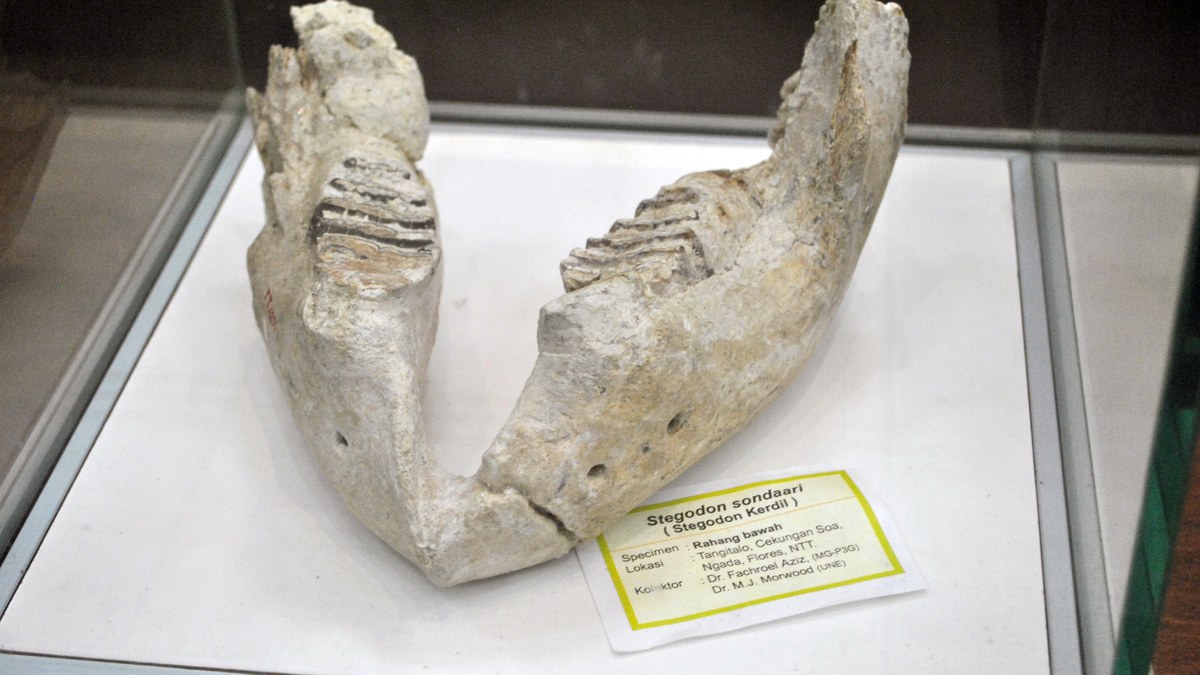
The district collector, Rohit Sisonia, sent the Deori tehsildar to the riverbank that night, and a watchman has been stationed there around the clock ever since. On Friday, a four-member team from the Geological Survey of India arrived from Bhopal to look at what the river had given up. Their preliminary finding, reported by the Press Trust of India on 14 November, is that the object is the fossilised lower jaw of Stegodon namadicus — an extinct relative of the modern elephant, a giant that walked central India in the deep past. The identification is provisional. Only a portion of the jaw is visible so far: roughly a foot high and a foot and a half across, lying upside down in the mud, its molars and premolars still intact, the rest of it still buried beneath the riverbed. Standing water has kept the team from digging any further for now.
It is a strange, small, perfect Odd Page story — a discovery made by children at bath time, a village divided between worship and fear, and a scientific question that nobody can yet answer with confidence. Because the most interesting thing about this jaw is not what it is. It is how old it is. And on that point, nobody agrees.
Three numbers that do not agree
Several Indian news reports have described the jaw as 6.5 million years old — sixty-five lakh years, in the Indian reckoning. That is a very large number, and it has travelled fast. It is also, on the evidence available, the least reliable number in the story.
The Geological Survey of India's own assessment places the fossil somewhere between the Miocene and the Pleistocene — a span running from roughly 6.5 million years ago to 11,800 years ago. Read carefully, that is not a date. It is a range so wide it contains almost the whole history of the genus. The 6.5 million years is the oldest boundary of that range, not a measurement of this specimen.
The animal's proposed identity points the other way. Stegodon namadicus inhabited central India during the Middle to Late Pleistocene, the long ice-age period that ended less than 12,000 years ago. If the identification holds, the jaw is far more likely to be tens of thousands of years old than millions.
Biologist Ravi Upadhyay, who examined photographs and video of the discovery, put his own initial estimate at between 11,000 and 25,000 years — and cited a separate assessment giving a much broader range, from 24,000 to 500,000 years. Only laboratory testing will narrow it down, and the GSI team is expected to submit its report to senior officials shortly.
This is the honest state of things, and it is worth stating plainly: a fossil can be found in a morning and dated only after months of work. The headlines have chosen the biggest number. The scientists have not. I would rather record the disagreement than pretend it does not exist.
The animal in the mud
What the scientists can say, with more confidence, is what kind of animal this was. Stegodon takes its name from the Greek stégō, to cover, and odoús, tooth — a name the British palaeontologist Hugh Falconer gave the genus in 1857 for the distinctive ridges on its molars. The teeth are the giveaway. Stegodon molars are built from parallel plates of enamel that form low, closely spaced ridges, made for grinding vegetation — a design superficially like an elephant's, but with its own character. P. K. Kathal, a retired senior professor at Sagar University, told the PTI-Bhasha news agency that the Narmada animal stood roughly 3.2 metres — about ten and a half feet — at the shoulder and weighed an estimated 7.5 tonnes. It was, by his account, a herbivore, and its great ridged teeth were its millstones.
The genus as a whole ranged from the Late Miocene to the Late Pleistocene, and its Indian species — S. namadicus, S. insignis, S. ganesa — lived from the Pliocene into the Late Pleistocene. They were among the largest land animals of their time. A single tusk of S. ganesa from the Early Pleistocene of India measured 3.89 metres long and weighed an estimated 140 kilograms — among the largest tusks ever recorded in a proboscidean. The Narmada animal was smaller than that record-holder, but it was still a giant: half as tall again as a large modern elephant, and more than twice as heavy.
There is a small, pleasing aptness in the name. Namadicus points back to the Narmada itself — the river that has now given one of these animals back. Fossils of Stegodon have been found in the alluvial deposits of the Narmada Valley before, and in several other parts of peninsular India. The river has been handing over giants for a long time. This one simply arrived in front of witnesses.
Prayer, fear, and the Mahabharata
The part of the story that will stay with me is not the measurements. It is the flowers and the coconut.
When the children found the jaw, the village did what villages have always done when the ground gives up something inexplicable: it reached for the oldest explanations it had. Some villagers regarded the find as a divine miracle and began offering prayers. Others feared the jaw had belonged to an ancient demon. Village elders recalled stories connecting that stretch of riverbank to the Mahabharata, including an account of elephants being sacrificed in a sacred fire ritual. There is no historical or scientific evidence to support those stories, and I record them here as what they are — the lore of a place, told by people standing on ground that had just surprised them.
But there is a reason the lore exists, and it is worth pausing over. The Narmada valley has been yielding prehistoric remains for two centuries, and the people who live along it have been finding them for far longer than the scientists have. Fossil hunters began paying attention to the region in the 19th century. In 1982, the Geological Survey of India geologist Arun Sonakia uncovered a human skullcap on the river's northern bank near Hathnora village — the Narmada Human, found among the remains of horses, pigs and Stegodon, and still the oldest known human fossil from the Indian subcontinent. Raisen district, where Patai sits, has produced other traces of ancient life as well: structures resembling dinosaur eggs were identified there about a decade ago, and the district is home to Bhimbetka, the UNESCO World Heritage Site of prehistoric rock shelters. Villagers along this stretch of the valley have reported finding unusually large bones for years.
Upadhyay has called for a systematic scientific survey of this section of the Narmada valley. He is right to ask. A place where children keep tripping over giants in the mud is a place that has not yet been properly looked at.
What happens next
For now, the jaw stays where the river left it, under guard. Sisonia has sought assistance from both the Archaeological Survey of India and the Geological Survey of India, and he has said what will happen if the tests confirm what the fossil appears to be: after chemical and archaeological examination, it will be kept in a museum.
That is the correct ending for a fossil, and a slightly sad one for a village. The flowers and the coconut will be cleared away. The watchman will go home. The jaw will be lifted out of the riverbank, cleaned, measured, catalogued, and put behind glass, where schoolchildren will file past it and read a label that gives its name in Latin and its age in numbers that are, for now, still in dispute.
But something will remain at Patai Ghat after the museum takes its prize. The next time children go down to the river to bathe, they will know that the mud under their feet can hold a giant's jaw — that the ground they have walked on all their lives is older and stranger than anyone told them. A fossil is a fact. A village that has prayed to one and feared one, in the same afternoon, has learned something no label in a museum can teach: that the past is not behind us. Sometimes it is lying in the riverbank, waiting for small hands to find it.
---
Sources, in plain text: Press Trust of India, 14 November 2026; The Daily Galaxy, 16 November 2026; Wikipedia, "Stegodon" (read 16 November 2026); Inshorts / Mid-day, 15 November 2026. Corrections are welcome. If a source named here has been misread, or if a better source exists, write to the correspondence address on the contact page. A correction that changes the meaning of an entry will be noted in the entry itself. The age of the jaw is not settled — the "6.5 million years" headline figure is the oldest boundary of the Geological Survey of India's Miocene–Pleistocene range, not a measurement; other estimates put it at 11,000–25,000 years or 24,000–500,000 years — and the identification as Stegodon namadicus is provisional, pending the Survey's report.