There is a particular kind of discovery that does not begin with a grant, a survey, or a team. It begins with one person, on a slope, looking at something that should not be there. Kurt Walde had been looking at it for three and a half years. From a peak in the Dolomites he had spotted a black mark on the mountainside, a dark smudge against rock the colour of the moon, and he could not leave it alone. He was convinced there was something interesting there. "I have to go and see it up close," he said.
Walde is a mountain guide from Brunico, in South Tyrol, and he has been guiding for 41 years. He is one of only two guides to the Conturines cave, a famous Ice Age site on the same mountain, and for all those years of leading visitors through it he had carried a suspicion with him. "During all [those] tours, I always had a feeling that this cave is not all there is to it," he told the BBC. "I thought there must be something more."
In July 2026, he finally went to find out. The slope below the summit was near-vertical and littered with loose rock. Walde descended from the top carrying a backpack that weighed 22 kilograms — about 50 pounds — and he had not been feeling well that morning. He reached a ledge he thought would be the cave. It was a false hope. "At that moment I felt a bit desperate," he says. He kept downclimbing, and then he reached the end of his rope. Literally. There was no more rope, and the cave was still below him. For the last few metres, he dispensed with the rope altogether and reached the entrance without it.
Inside, in the glow of his headlamp, was a graveyard.
A room full of bones
The first stretch of the cave runs straight for about 60 metres — 200 feet — to a large speleothem, a natural mineral deposit, at the end of that passage. Nearby, on an elevated formation of bedrock that looked like a table, lay a solitary bone. The arrangement struck Walde as "mysterious". From that point the cave descends to the left, and it was there that he came across numerous bones and skulls — so many that he remembers walking on eggshells to avoid disturbing them. One skull, he noticed, was still connected to its cervical vertebrae, the bones of the neck, as if the animal had lain down and never been moved.
It dawned on him that this had once been a place "full of life" and activity, so long ago. "That was the strongest sensation," he says.
The bones are suspected to belong to *Ursus ladinicus*, a species of cave bear that went extinct around 24,000 years ago. I say "suspected" because the identification is not yet settled: the South Tyrol authorities' own press releases name the animals as *Ursus spelaeus* or *Ursus ladinicus*, and the research that would decide the question has not yet begun. What is not in doubt is the scale. Christian Terzer, director of the Province of Bolzano's Department of Archaeology, visited the site in early autumn and told the BBC: "I was impressed with the number of bones. There are hundreds and hundreds of bones there. I don't know how many individual bears are inside, but it's quite a lot." Terzer is also "quite sure" that the new cave holds "far more specimens than in the Conturines Cave" — the sister cave across the mountain, which for nearly forty years was the only place in the world where *Ursus ladinicus* remains had been confirmed.
The new cave sits at a little over 2,850 metres — 9,350 feet — above sea level, on Col Toronn, below the Conturines peak, inside the Fanes-Senes-Braies Natural Park in northern Italy. It is about 170 metres long. Walde discovered it on 3 July 2026 and reported the find to the provincial authorities on 17 July. It has now been sealed behind a metal grille, with a monitoring system watching the entrance, and it will stay that way through the winter. Scientific work inside is not expected to resume until June 2027.
The sister cave
To understand why a second cave matters so much, you have to know the first one. The Conturines cave was discovered on 23 September 1987, when Willy Costamoling found cave bear remains high on the same mountain. It transformed what scientists knew about Ice Age cave bears. Some of the bones there belonged to the common cave bear, *Ursus spelaeus*. Others were eventually found to belong to a previously unknown species, *Ursus ladinicus*, named in honour of the Ladin community who live in the mountains where it was found. Research suggests the bones in Conturines date to at least 46,000 to 50,000 years old — and I should be precise here, because it matters: that date belongs to the Conturines cave, not to the new one. Nobody has yet published a date for the bones Walde found.
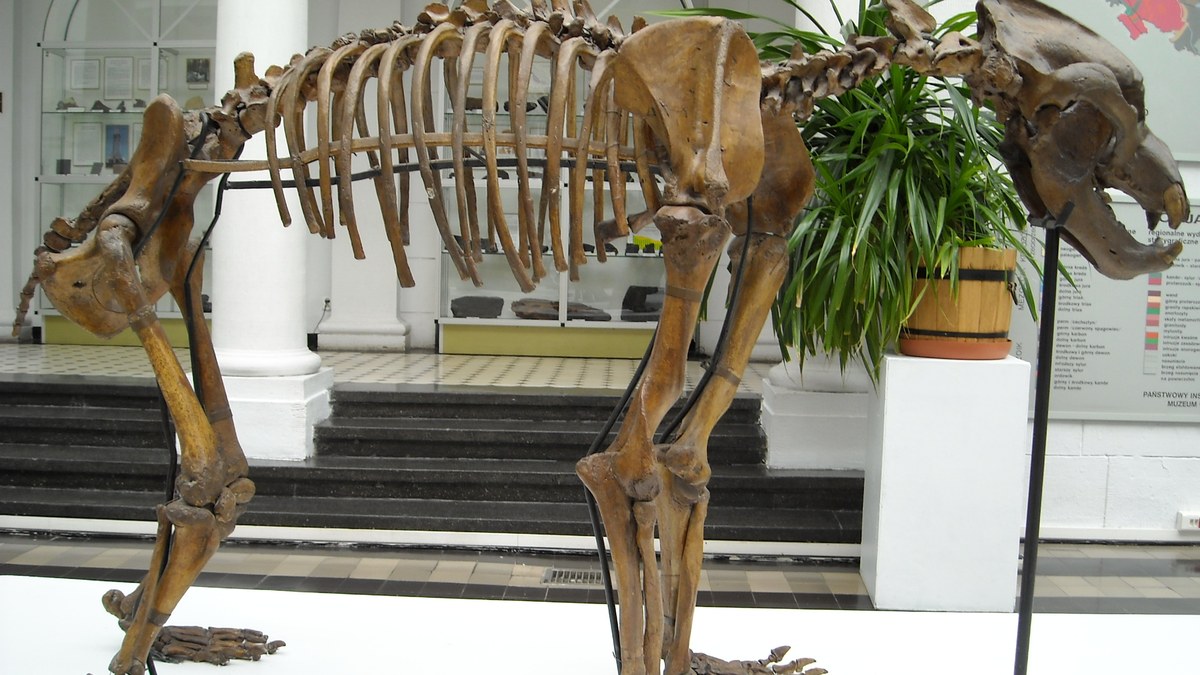
The Conturines bears were enormous. They weighed around 1,200 kilograms — 2,650 pounds — and measured about 3 metres, or 10 feet, long, with males larger than females. Their teeth suggest they were exclusively plant-eaters, feeding on Alpine herbs, leaves, and tougher grasses. The cave is also a climate time capsule: some of the mineral deposits it holds are, according to research cited by the BBC, around six million years old, and evidence from the cave suggests the Dolomites could have been warmer than today's average when the bears lived there, with the beech tree line at a higher altitude — potentially providing food for the bears.
The bears were not alone in those mountains, either. A cave lion jawbone and a separate tooth were found in Conturines, and the remains of cave hyenas, lions, and leopards have turned up in other Alpine caves from the same era. It was a crowded, dangerous landscape, and the caves were part of it.
Original bones, teeth, and skulls from Conturines — including a complete skeleton — are on display at the Museum Ladin Ursus ladinicus in San Cassiano, in the valley below. The museum labels the animal *Ursus spelaeus ladinicus*, which tells you something about how unsettled the naming still is, nearly forty years on.
A race to seal the door
One of the first people Walde's discovery reached was Christian Terzer, and the timing could hardly have been worse for him. Terzer had only taken up his post as director of the archaeology department in early August 2026, and the discovery landed on his desk as he began the job. It was, by his own account, something of a baptism of fire. It was only after discussing the find with local palaeontologists that he realised its significance, and then a second worry set in: contamination, and looters. "I also had some sleepless nights," he told the BBC.
The fear was not abstract. The discovery had attracted widespread public and media attention, and a cave full of Ice Age bones is exactly the sort of place that draws people who should not be there — even one whose entrance sits on a near-vertical rock face at nearly 3,000 metres. So the department moved fast. A gate was erected some 20 metres inside the opening, with an additional tarpaulin further in to seal off the crucial evidence. The material had to be airlifted to the cave, which, at that altitude and on that slope, was no easy feat. The work was done in consultation with the State Domains Agency and the Office for Nature, because the cave lies inside a protected Natura 2000 area.
By October, the site was secured: a purpose-built metal grille across the entrance and a monitoring system in place. The province's press releases, notably, give no count of the skeletons and no age for the bones — the research is only beginning, and the officials have been careful not to get ahead of it.
The questions waiting in the dark
What makes this find more than a big pile of bones is the list of questions it leaves hanging, and the scientists involved are refreshingly open about how little they know yet.
The first question is the simplest and the hardest: how did the bears get in? The cave's mouth, as it appears now, is highly inaccessible — Walde needed a rope, and then ran out of rope, just to reach it. But the cave must once have been accessible to bears. There must have been no ice blocking it, and the temperatures would have to have been suitable for them. Martina Pacher, a vertebrate palaeontologist at the Natural History Museum of St Gallen who works mainly on cave bears and Ice Age fauna — and who took part in the excavations at the 1987 cave as a student — puts it plainly: the entrance may have changed over the millennia, but it is too early to tell how, or by how much.
The second question is whether the two caves are connected. There is currently no visible connection between the new cave and the 1987 one. But Walde, on entering, was struck by the topographic similarities between the two caverns, and his first thought was that "this den must be part of a cave system". Pacher agrees it is possible: "The old Conturines Cave and this new one may probably be connected somehow, but we're not sure yet."
The third question is the oddest, and the one that would have caught the eye of anyone who collects strange footnotes of the past: the solitary bone on the stone table. It was not the only unusually placed bone. Terzer noticed several of them — isolated bones set on big rocks, where no flood or fall of rubble obviously put them. "It's strange that some isolated bones are placed on big rocks," he says. "We will have to find out how [they ended up there]. Maybe through a natural process, or maybe there were humans inside thousands of years ago." He does not claim the human explanation. He leaves it open, which is exactly the right thing to do when the research has not started.
And the fourth question is what the bones themselves will say, once the scientists are allowed back in. Pacher hopes the discovery will help answer what the bears actually looked like: "If we find many more-or-less complete skeletons we have much better possibilities to reconstruct the appearance of these bears." More skeletons beneath the sediments, or bones that can be rearticulated later, might tell us about family ties and social behaviour — things a single skeleton cannot. Spyridoula Pappa, a senior curator of fossil mammals at London's Natural History Museum who has worked on teeth from the Conturines cave, is excited by the prospect of "a much more complete assemblage" of bones, and hopes it will allow scientists to extract evidence from teeth, skeletons, genetic material, and geological context to build a much fuller picture of these "remarkable alpine bears". She adds a caution that belongs in any honest account: "We also need to see if they're all cave bear remains."
Sealed until summer
For now, the cave is shut. The gate is in place, the tarpaulin is up, and the mountain is going into winter. Terzer and his team will spend the cold months planning, and the scientists intend to resume work inside from June 2027. Walde, for his part, hopes to return to the cave one day — perhaps in ten years' time — and to find it in the same condition as he found it.
There is something fitting about the delay. The cave waited, unentered, for tens of thousands of years while the world changed around it; it can wait one more winter while the people who found it work out how to enter it without ruining it. Walde spent three and a half years staring at a black mark on a cliff before he climbed up to look at it. The bears, the bones, and the bone on the table have waited far longer than that. They are not going anywhere. The oddest thing about this story may be that, after a discovery like this, the most important thing anyone did was to lock the door and walk away.
Sources, in plain text: BBC, 14 November 2026 (read via a republication of the BBC text at everywherenews.net); Earth.com, 30 October 2026; Heritage Daily, 23 October 2026. Corrections are welcome. If a source named here has been misread, or if a better source exists, write to the correspondence address on the contact page. A correction that changes the meaning of an entry will be noted in the entry itself. The number of individual bears is not known, the new cave's bones are undated, and the species is not confirmed — the province's press releases name the animals as Ursus spelaeus or Ursus ladinicus.