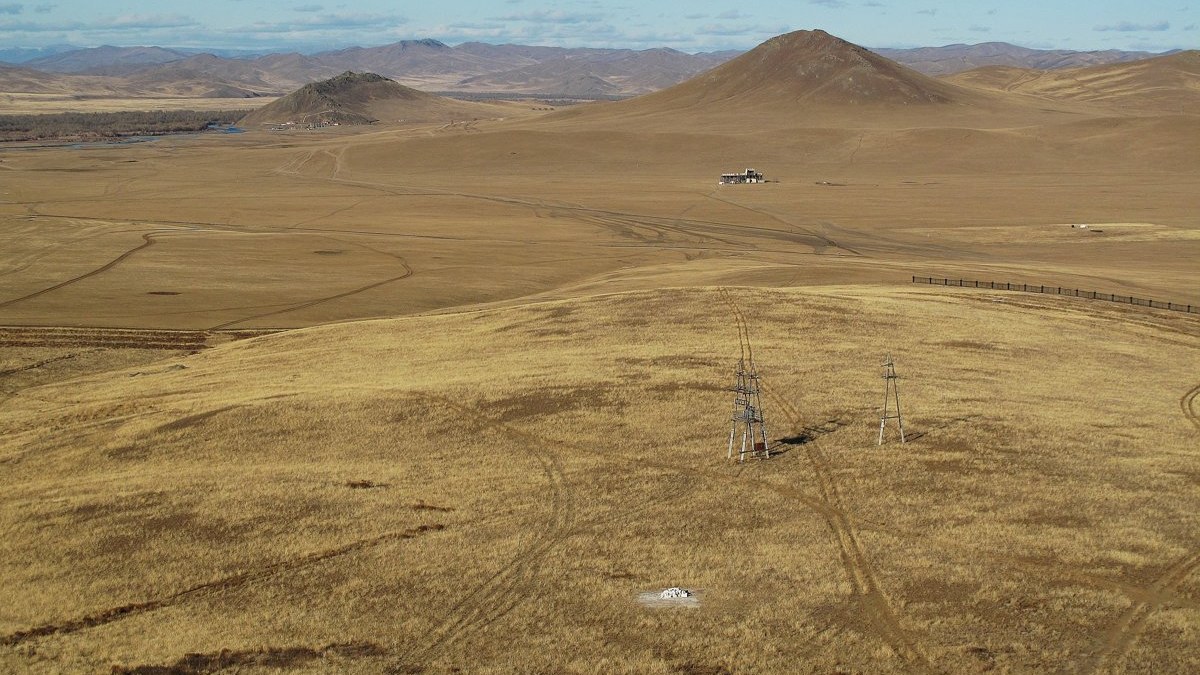
There is a place in the steppe of eastern Mongolia where the ground keeps a secret in plain sight. Duurlig Nars is a cemetery of some three hundred tombs, the largest group of Xiongnu burials in eastern Mongolia, first noted by archaeologists in 1974. For decades it was known and, for the most part, left alone. Then, in 2023, a joint team from Korea and Mongolia began to dig into its largest mound — Tomb No. 160 — and did not stop for four years. On 6 November 2026, the National Museum of Korea announced that the excavation was complete, and the results read like a riddle: the largest Xiongnu tomb ever identified in Mongolia, built for a person of the highest rank, whose burial chamber turned out to be unexpectedly small.
The tomb is about seventy-three metres long, counting the entrance passage that runs south from the mound. To reach the burial, the excavators had to remove nine separate layers of stacked stone, working down to a depth of about fourteen and a half metres. The scale of the labour alone tells you something about the person buried there. In the steppe, where stone must be gathered and carried and a mound must be raised by hand, a tomb of this size is a statement. It says: this person mattered, and everyone for a long way around was expected to know it.
And then, at the bottom of all that stone, the chamber itself. Two layers of wooden outer coffin enclosing an inner coffin — the proper, careful architecture of an elite Xiongnu burial — but small, and shallow. Comparable tombs of the same rank in central Mongolia reach depths of twenty-two metres. Tomb No. 160 stops at fourteen and a half. The same reduced scale had already appeared in a satellite burial nearby, surveyed in 2019, and the excavators are treating the pattern as evidence rather than accident. The tomb was built in the late first to second century, when the once-formidable power of the Xiongnu was gradually declining. A smaller chamber inside a grander mound may be a clue to what that decline looked like from the inside — a society still able to command enormous labour, but no longer building quite as it once had. That is an interpretation, not a proven fact, and the museum has presented it as such. It is the kind of detail that makes an old tomb feel like a document: not a monument to a single life, but a record of a world changing.
Four hundred and thirteen objects, three continents
From the central chamber, the team recovered 413 artifacts. The count matters less than the geography. Laid out together, the objects in this one Mongolian grave point in three directions at once: west toward Rome, south toward Han China, and east toward the Korean Peninsula.
The most talked-about object is also the least certain. It is a transparent glass cup with a handle, found in the chamber, which may have been made within the territory of the Roman Empire. The museum has been careful with this claim, and so should we: the cup's origin has not been established. Compositional analysis will be carried out to pinpoint where the glass was made, and until that work is done, "possibly Roman" is the honest description. What is certain is that a handled glass vessel of this kind had travelled an extraordinary distance to reach a grave in the eastern steppe, by whatever road it came.
The Chinese connection is firmer, and stranger. Fifteen pieces of jade were found laid in overlapping layers on the floor of the coffin, modelled on the *bi* disc — the round, pierced jade disc of Han funerary practice. But these are not ordinary *bi* discs. Their shapes are irregular, and their surfaces carry extremely intricate carvings. The researchers believe the Xiongnu adopted Han funerary culture while reworking its forms: the idea arrived from China, and the execution was their own. That is a small, telling detail. It suggests not mere trade, not goods passing from hand to hand, but a culture borrowing a neighbour's ritual language and speaking it with its own accent.
The Korean connection is the most precise of all. Among the finds is a silver horse ornament — a harness pendant, made by hammering a thin silver sheet into a gourd shape, with a crystal set at its centre. It closely resembles ornaments excavated from tombs of the Lelang commandery in Pyongyang, including Tomb No. 219 at Seogam-ri, held by the National Museum of Korea. The difference is the crystal: the Mongolian piece sets a clear stone where the Pyongyang examples set agate. Alongside it, the team found a round gold ornament backed with gold leaf and red and blue material beneath its crystal, so that light and colour glow softly through the transparent stone. Ornaments of this kind have now been identified in a Xiongnu tomb for the first time, and the museum says it is the first time artifacts of such quality have been identified in eastern Mongolia at all.
There were other things, too, the kind of objects that fill out a life rather than a trade route. A gilt-bronze table leg, lacquered, shaped like a horse's leg. And directly above the central chamber, buried as part of the same monument, a lacquered carriage — another symbol of high status, placed where it would sit over the dead like a roof.
The person we do not know
For all the richness of the grave goods, the person at the centre of Tomb No. 160 remains unknown. We do not know the occupant's name, sex, or age. We do not know whether they ruled, advised, fought, or merely inherited. The bones themselves have not yet told their story — but they may. Teeth and hair were recovered from inside the coffin, and DNA analysis is planned. If it succeeds, it may reveal not only the sex and age of the occupant but also their relationship to the people buried in the satellite graves around the mound. The museum has said it expects a far more concrete picture of Xiongnu society to emerge from that work.
It is worth pausing on how much of this story is still, properly, unfinished. The glass cup awaits its chemical analysis. The DNA awaits its sequencing. The full findings were presented for the first time at the fiftieth national conference of the Korean Archaeological Society, held in Gangneung on 6–7 November 2026, and a full excavation report will follow after further research. The artifacts themselves will be brought to South Korea by the end of the year for conservation treatment and scientific analysis, with two Mongolian researchers taking part as conservation trainees. Records of the entire excavation, captured in three dimensions, will be turned into digital content for people who cannot visit the site.
This is how archaeology actually works, most of the time — not as a single revelation but as a slow accumulation, with each answer arriving on the condition that it may be revised. A tomb is opened; the objects are counted; the claims are qualified; the real conclusions wait for the laboratory.
Thirty years of looking
The excavation is also the product of a long patience. The National Museum of Korea has surveyed the Mongolian steppe since 1997 — nearly thirty years — precisely because understanding the Xiongnu is an important part of tracing how ancient Korean culture took shape. The Xiongnu were a nomadic empire that commanded eastern Eurasia from the Mongolian steppe around the turn of the Common Era, maintaining close ties with societies in Manchuria and on the Korean Peninsula, including Gojoseon and the Lelang commandery. That long Korean presence in Mongolian archaeology laid the groundwork for something larger: in July 2026, Xiongnu tomb sites including Duurlig Nars were inscribed on the UNESCO World Heritage List.
The site has also drawn attention at the highest level. On 21 August 2026, while the excavation was under way, Mongolian President Ukhnaa Khurelsukh visited Duurlig Nars — the first time a Mongolian president had visited an excavation site in person. The museum described the joint Korean–Mongolian survey as a clear symbol of the friendship and cooperation between the two countries and their peoples.
There is a pleasing symmetry in that. A tomb built to display the reach of a steppe empire now displays the reach of the scholarship that studies it: Korean archaeologists, Mongolian archaeologists, a UNESCO listing, a president's visit, and a set of objects that will travel to Seoul for conservation before their story is finally written down. Two thousand years ago, someone in this grave owned a cup that may have come from Rome, jade worked in the manner of Han China, and silver that matches the tombs of Pyongyang. The world was already connected. We are only now learning how to read the evidence of it — one layer of stone at a time, nine layers down.
Sources, in plain text: Seoul Economic Daily (English), 6 November 2026 (National Museum of Korea announcement); Arkeonews, 10 November 2026; La Brújula Verde, November 2026; Seoul Economic Daily (English), 28 July 2026. Corrections are welcome. If a source named here has been misread, or if a better source exists, write to the correspondence address on the contact page. A correction that changes the meaning of an entry will be noted in the entry itself. The glass cup's Roman origin is not established, the occupant's identity, sex and age are unknown, and the Xiongnu–Hun identification is not asserted here.