Some legends are polite enough to stay legends. They give you a hero, a mountain, and a name that still clings to the grass, and they ask for nothing in return except to be repeated. The Welsh tale of Macsen Wledig is one of those — except that, in October 2026, a patch of Pembrokeshire ground started answering back.
The tale belongs to the *Mabinogion*, a collection of medieval Welsh stories. In *The Dream of Macsen Wledig*, the emperor Macsen is haunted by a vision of a beautiful stranger he has seen only in sleep. He searches for her, finds her in Britain, and marries her. In return for her hand, the story has him conquer the island for her father. At one point in his travels he climbs Frenni Fawr, a 395-metre peak in the Preseli Hills, and pitches his tent there. The tale says that encamping place is called Cadair Maxen — the Chair of Maxen — "even to this day."
For a long time, that was the whole of it: a good story, attached to a real hill, with no Roman camp or fort known on the hill or below it to give the story a foothold. Then Dr Mark Merrony, a Supernumerary Fellow of Wolfson College, Oxford, found something that did not fit the empty map.
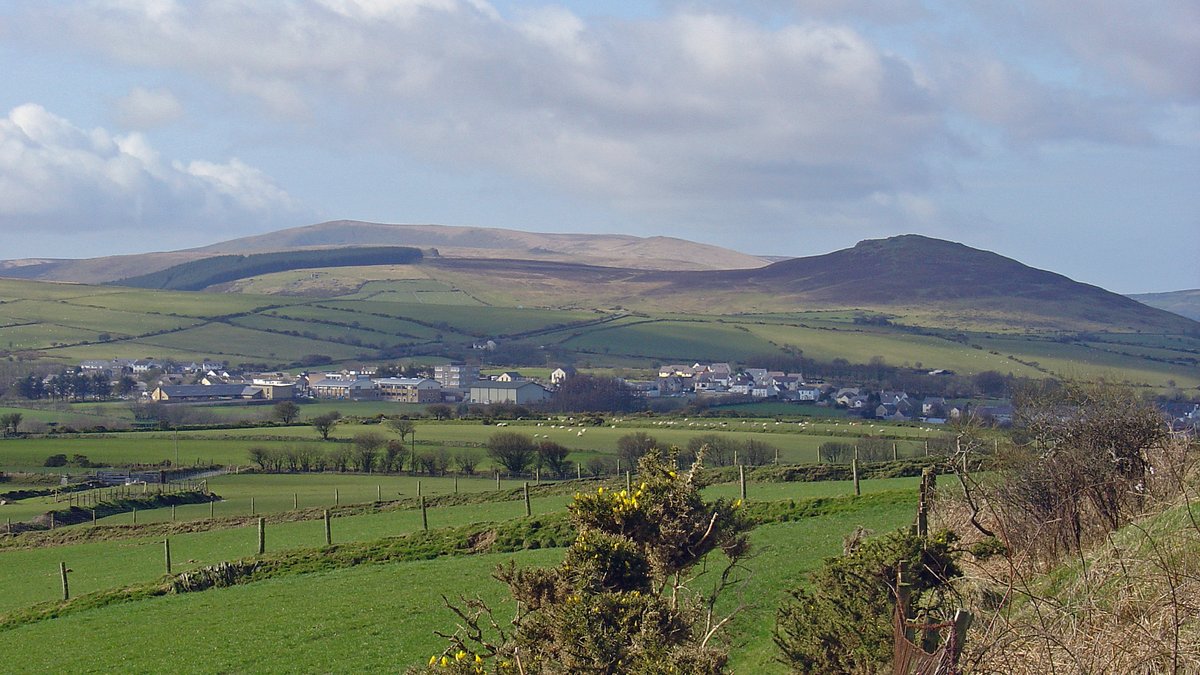
Merrony first identified the site in 2024, using satellite imagery. What he saw, beneath vegetation in an overgrown field, was a rectangular outline with rounded corners — the playing-card shape Roman surveyors favoured for a fort. Wolfson College announced the discovery in October 2026, after further investigation had turned up Roman pottery, tiles, an iron stylus, and coins dating from the late fourth century. The fort lies near Frenni Fawr in Pembrokeshire, roughly three and a half kilometres south-west of the summit — about two miles, close enough to see the peak, and close enough for the comparison with the tale to be unavoidable.
That closeness is the whole argument, and it is worth stating plainly before anyone gets carried away. Merrony is not claiming that he has found Macsen's tent. He is claiming something both smaller and stranger: that a medieval story about an emperor camping on this particular hill may preserve a memory of a real Roman military presence in this particular landscape. Wolfson College itself puts it carefully, saying the discovery "could lend archaeological support" to the legend and that further research will be needed to establish any connection with Magnus Maximus. That caution is not decoration. It is the difference between a discovery and a headline.
To understand why the claim is even plausible, you have to meet the man behind the Welsh name. Macsen Wledig is the Welsh form of Magnus Maximus, a real fourth-century ruler. He was a Spaniard who had commanded Roman soldiers against the Picts and the Scots. In 383, his troops proclaimed him emperor in the West, in place of the unpopular Gratian. He held that claim until Theodosius I defeated him; Maximus was captured and executed in 388. That five-year arc — soldier, usurper, emperor, corpse — is history. What Welsh storytellers did with it afterwards is something else: the twelfth-century chronicler Geoffrey of Monmouth fictionalised Maximus's life, turning him into a Christian king of Britain who married a Welsh princess, traditionally identified as Elen Luyddog. From there, the professional storytellers of Wales gave Macsen Wledig a place in legend second only to Arthur, in the words of the Welsh politician and author Gwynfor Evans, quoted by Smithsonian Magazine.
So the tale is not a contemporary report. It is a medieval romance built around a real man, centuries after he died, in a landscape that storytellers knew. That is exactly why a fort matters. If there had never been a Roman fort anywhere near Frenni Fawr, the tale's geography would look like pure invention — a famous name pasted onto a convenient hill. If there was one, the geography starts to look like something else: a memory, distorted by retelling, but anchored to a place where soldiers really were.
The ground, so far, supports the second reading better than the first. After the satellite identification, Merrony carried out a geophysical survey and trial excavations. A breakthrough came in early September 2026, when excavators found bases of floor structures built of clay and packed with the remnants of thin stone blocks, along with traces of a Roman road, a kiln, flooring consistent with a Roman granary, pottery shards, and a spindle whorl — the small weight used in spinning thread. A game piece and fragments of ceramic tile were also reported. Taken together, those are not the leavings of a marching camp thrown up for a night or two. They look like a timber auxiliary fort: a permanent, or at least long-lived, base for non-citizen support troops, with a headquarters building, a commander's house, stores, and the ordinary clutter of people living and working there.
How big was it? Here the numbers need handling with care, because they have already moved once. Early reports put the stronghold at as much as three hectares — roughly 180 by 150 metres — room for around 500 soldiers. In a follow-up reported on 29 October 2026, Merrony revised that estimate upward, saying the site was bigger than the housesteads on Hadrian's Wall, which held 1,000 troops, and that it could have held up to 1,000 auxiliary Roman soldiers. Neither figure is a headcount. No one has counted 500 or 1,000 men. Both are estimates from the size and layout of the enclosure, and the later figure is the larger, later estimate. An honest article should give you both, in that order, and let you see that the estimate grew as the site was better understood — not pretend that a single confident number was there from the start.
The dating is where the story gets its sharpest edge, and also its weakest joint. Two coins from the late fourth century have been found at the site. That is the period of Maximus himself: proclaimed in 383, dead in 388. It is easy to see why those two small discs have done so much work in the coverage. They place activity at the fort in the same decades as the emperor of the legend. But a coin is not a diary entry. Coins stay in circulation for decades, they are lost, dropped, hoarded, and carried far from where they were minted. Two late-fourth-century coins prove that someone in the late fourth century was at, or passed through, this site with money in their pocket. They do not prove that Magnus Maximus stood there, pitched a tent there, or ever heard the name Frenni Fawr.
Merrony himself does not claim that Maximus built the fort. His argument, as reported by Smithsonian Magazine from his own writing in *The Conversation*, is that the Roman governor of Britain, Sextus Julius Frontinus, established it between 74 and 78 — more than three hundred years before Maximus was proclaimed emperor — and that Maximus could have used, or known about, the site centuries later. That is a coherent theory: a fort built in the first century, still standing or still known in the fourth, available to an emperor moving through Wales. It is also, at this stage, a theory. Reports note that the excavation has not yet been published in a peer-reviewed journal, with publication in *Antiqvvs* still being prepared. Until that publication appears, the founding date, the length of occupation, and the fort's exact role in the Roman military organisation of west Wales remain open questions, not settled facts.
There are other cautions, and they deserve the same airtime as the excitement. The tale places the emperor's camp on the summit of Frenni Fawr. The fort is not on the summit; it is a few kilometres below and to the south-west of it, in a field. Merrony's answer to that gap is practical rather than poetic: a Roman army did not need to camp on a bare peak when a visible, established fort lay a couple of miles away, in sight of the mountain. "If Magnus Maximus was there, there must have been an army there," he told *The Guardian*. "It's such a remote area, but the tale mentions the easternmost peak of the Preseli Hills, which is where this site is." That is a reasonable piece of reasoning, but it is reasoning, not proof. Medieval manuscript readings of the place-name also vary, and other commentators have stressed that the fort's location differs from the precise hilltop setting described in the tale. A story can remember a landscape without remembering it exactly.
Merrony has also offered a possible reason for Maximus to be in the region at all, theorising that he may have visited in response to incursions by Irish groups during the fourth century, before departing Britain for continental Europe. That, too, should be read as a theory offered by the excavator, not as an established itinerary. No source found for this draft records a dated, documented visit by Maximus to Pembrokeshire, and this draft does not invent one.
What, then, has actually changed? Before October 2026, the Macsen story had a hill and no fort. Now it has a hill and a fort, a few kilometres apart, with late-fourth-century coins in the ground between the legend and the archaeology. That is a real shift, and it is also a modest one. It does not turn a medieval romance into a military dispatch. It does something quieter and, to my mind, more interesting: it suggests that the people who told this story were not inventing a landscape out of nothing. They were telling a tale about a real emperor, and setting part of it in a part of Wales where the Romans really had built, really had marched, and really had left tiles, pottery, and coins in the earth for someone, many centuries later, to notice from a satellite image and then, on a bicycle ride, from a roofing slate poking out of the ground.
That is the proper shape of an odd footnote of the past. Not a mystery solved, but a mystery given a new address. The fort is real. The coins are real. The emperor was real. Whether the emperor and the fort ever met is still, for now, a question — and the best thing about this discovery is that it gives archaeologists a place to go looking for the answer, instead of a hilltop with nothing on it.
Sources, in plain text: Wolfson College, University of Oxford, announcement, October 2026; Smithsonian Magazine, 16 October 2026; Fox News Digital / New York Post, 29 October 2026; The Wild Hunt, 28 October 2026. Corrections are welcome. If a source named here has been misread, or if a better source exists, write to the correspondence address on the contact page. A correction that changes the meaning of an entry will be noted in the entry itself. The visit by Magnus Maximus to this fort is a theory, not an established fact, and the fort's founding date and garrison size are estimates, not settled counts.