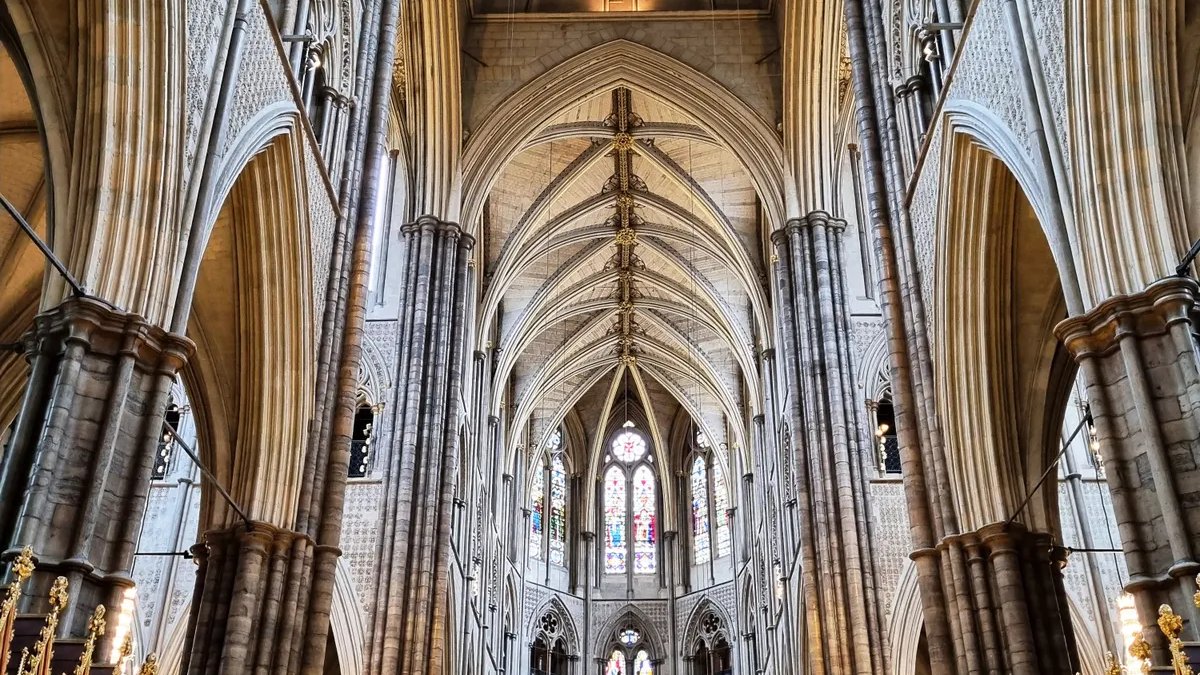
There is a particular kind of embarrassment that only old buildings can produce: the kind where a stone label, carved with great confidence, turns out to be describing someone else entirely. At Westminster Abbey, that embarrassment has now been given a name — or rather, it has had a name taken away.
The limestone sarcophagus in question was excavated on the Abbey's North Green in 1869. Its side carries a Latin inscription commemorating Valerius Amandinus, a wealthy Briton who lived in Roman London around AD 300 to 400. For a century and a half, that inscription seemed to settle the matter. A Roman coffin, a Roman name, a Roman burial. The story was tidy, and tidiness is usually the first sign that a story is incomplete.
The first clue that something was wrong was carved into the lid, in plain sight. Across it runs a large Latin cross, but the cross does not belong to the Roman period at all. It was cut in the tenth or eleventh century, some six or seven hundred years after Valerius Amandinus lived. A coffin does not acquire a new carving by accident. Someone, centuries later, had taken this old stone box and given it a second life.
For a long time, that second life could not be investigated properly, because the body itself was believed to be gone. Nineteenth-century records treated the skeleton as lost, perhaps looted or discarded during the coffin's various moves around the Abbey. Then, when the sarcophagus was opened during modern conservation work, the assumption collapsed: inside lay a nearly complete human skeleton, waiting out the decades in the dark. The bones, as Westminster Abbey's consultant archaeologist Professor Warwick Rodwell has noted, matched nineteenth-century drawings of the remains. The lost body had never really been lost. It had simply been left alone.
What followed was the slow, unglamorous work that actually solves historical mysteries: measurement, comparison, and dating, rather than revelation. Analysis by human bone specialist James Young Langthorne placed the dead man at between 35 and 49 years old and about 5 feet 9 inches tall. Radiocarbon dating placed his death between AD 987 and 1052. That single range changes everything. It means the man in the coffin died roughly seven centuries after the Roman named on its side. The inscription and the skeleton cannot be describing the same person, and the cross on the lid suddenly makes sense: this was a late Saxon burial, placed inside a Roman container.
It also tells us something about the man's standing. A wooden coffin had been placed inside the older stone one, and the lid had been recarved with a cross of a specific late Anglo-Saxon type, running the full length and width of the lid. Rodwell's argument, reported by The Guardian, is blunt: nobody of lower rank would have been buried in anything like that. A reused Roman sarcophagus was not a convenience purchase. It was a statement, and it points to a senior churchman of the monastery at Westminster.
That narrows the field to two men, both abbots of Westminster, both believed to have been buried at the Abbey, and both fitting the radiocarbon range. The first is Ælfwig, who died around 1020. The second is his successor, Wulfnoth, who died in 1049. Rodwell favours Ælfwig, and one reported reason is a small biographical detail with outsized weight: Ælfwig had already been a monk at Westminster before he became its abbot, which ties him more closely to the monastery than a newcomer would be. But — and this matters more than the favourite — the identification is not certain. The Abbey's own research findings leave the question open. There is no inscription naming the later occupant, no document recording the reuse, and no test yet performed that can put a personal name to these bones with absolute certainty. What we have is a strong, well-argued probability, not a solved case. Any account that presents Ælfwig as proven is overstating the evidence.
Rodwell has also reconstructed, in outline, what happened to the coffin after that medieval burial. The reused sarcophagus was most likely interred in the eastern arm of the Abbey church, with its lid serving as a floor slab, before being dug up and reburied during the construction work of Henry III in the thirteenth century. Think about what that means: the same stone box was buried, lifted, and reburied across centuries, its Roman inscription travelling with it like a label nobody bothered to update. By the time it was excavated in 1869, it had already lived several lives, and the Victorians who dug it up added one more, turning it into a museum object and a puzzle.
There is a temptation to call this a mystery solved, or a ghost story confirmed. It is neither. There is no evidence of anything supernatural here, and the real history is stranger than a haunting would be. What we have is a case study in how sacred places recycle themselves. Stone was expensive. A good sarcophagus was rarer still. When a monastery needed a fitting resting place for an abbot, an ancient coffin standing in its own grounds was not a curiosity to be preserved behind glass; it was a resource, ready to be carved, filled, and buried again. The past, in other words, was not something the monks of Westminster merely remembered. It was something they picked up and used.
That habit also explains why the building itself feels the way it does. Westminster Abbey is not a single moment frozen in stone. It is a stack of centuries, each one building on, burying, and occasionally mislabelling the one before it. A Roman inscription, a Saxon cross, a thirteenth-century rebuilding, a Victorian excavation, and a twenty-first-century laboratory analysis all meet in one object. The sarcophagus is now on permanent display in the Queen's Diamond Jubilee Galleries at the Abbey, where visitors can see the inscription and the later cross together, side by side, telling two different stories at once.
It is worth pausing on what the new research does not tell us, because the gaps are part of the story. It does not tell us where Valerius Amandinus himself was buried, or whether his remains were ever in this coffin at all; the inscription commemorates him, but commemoration and occupancy are not the same thing. It does not tell us why this particular sarcophagus was chosen for reuse, or who made the decision. And it does not resolve, finally, whether the bones belong to Ælfwig or to Wulfnoth. A thousand years after the burial, the most honest sentence available is still "most likely." That is not a failure of the research. It is the research working correctly, refusing to turn a probability into a plaque.
Archives teach the same lesson over and over: the label is not the thing. A name carved on a stone is evidence of what someone wanted remembered, not necessarily of what happened. The skeleton in Westminster Abbey's Roman sarcophagus spent more than a century being filed under the wrong name, not because anyone lied, but because the label was older, louder, and carved in stone, while the truth was quieter and buried inside. The cross on the lid was there all along, patiently disagreeing. It only took modern science, and a willingness to believe a carving over an inscription, to hear it.
The next time you stand in front of a monument and read a name, spare a thought for the possibility that the stone is telling you about two people at once: the one it names, and the one it actually holds. At Westminster, that possibility is now a matter of record. The coffin still says Valerius Amandinus. The bones say someone else. And for once, the bones have been allowed to answer back.
Sources, in plain text: Westminster Abbey research announcement, 21 October 2026, published in the Journal of the British Archaeological Association; The Guardian reporting, 21 October 2026; Smithsonian magazine report. Corrections are welcome. If a source named here has been misread, or if a better source exists, write to the correspondence address on the contact page. A correction that changes the meaning of an entry will be noted in the entry itself.