Most of what we know about the burials of Chimú elites has come to us second-hand, and not in a good way. It has come through platforms that were opened by looters, through objects that reached museums and private collections without their context, and through the gaps those objects left behind. That is why a single announcement from Peru in September 2026 matters more than its headline suggests. At Chan Chan, archaeologists uncovered a funerary platform that had not been looted. It had stayed shut, underground, for roughly six hundred years.
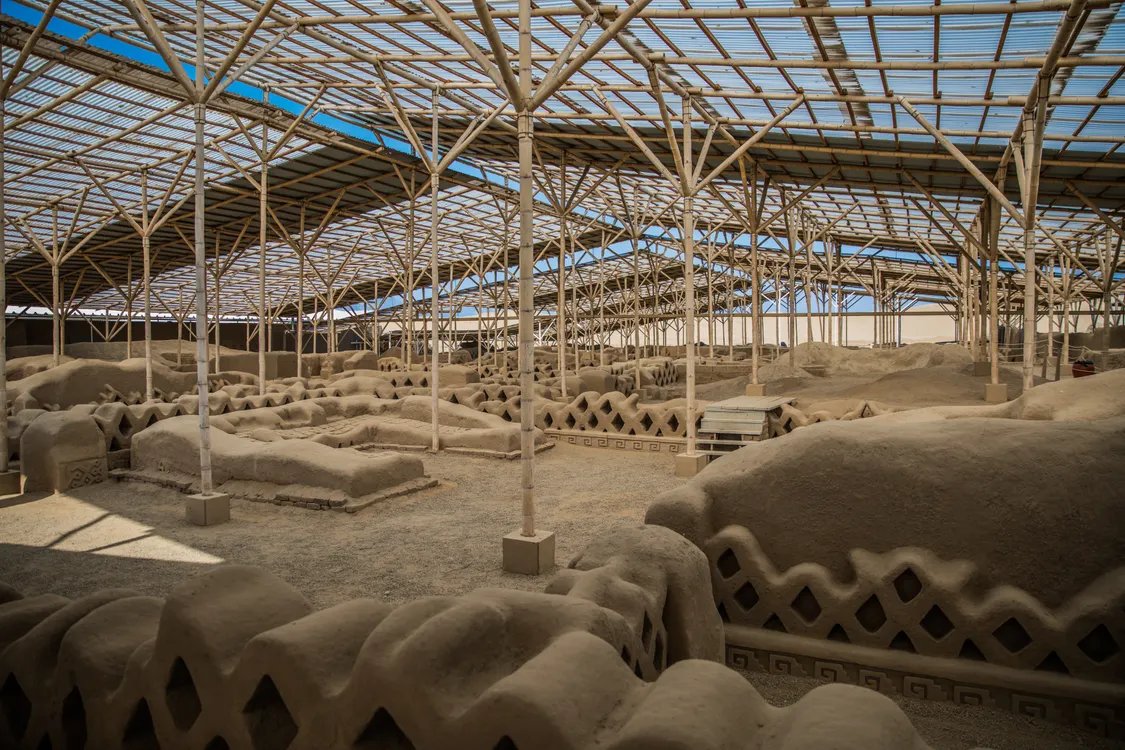
The announcement, made by Peru's Ministry of Culture on 8 September 2026 and reported by Smithsonian Magazine and The Art Newspaper, places the discovery in La Libertad, at Chan Chan's Utzh An complex, known as the Gran Chimú Palace. Chan Chan was the capital of the Chimú kingdom, which flourished in approximately 900 to 1470 CE, and it has been a UNESCO World Heritage site since 1986. The tomb is believed to have been built for prominent members of the Chimú kingdom. Its main chamber held one person. A side area held about twenty others. The rest of the funerary platform brought the total to at least thirty-eight people. Reports differ on how the platform total divides, with some accounts giving the remaining group as seventeen and others as eighteen, so this entry does not present a disputed split as exact. At least thirty-eight is the figure the record will support, and that is enough.
Among the finds were weapons, metal emblems, gold, copper and shell objects, and about sixty ceramic pieces, some of which show Inca-style choices. That last detail is worth pausing over, because the Inca came after the Chimú. A burial that already contains Inca-style work sits near a hinge in Andean history, at the point where one way of organising a kingdom was giving way to another. It does not, on its own, date the tomb precisely, and it does not tell us who ordered it built. It tells us that the people who arranged this burial were living in a world that was already changing, and that they chose objects that reflected more than one tradition.
Many of the skulls bore traces of red pigment, thought possibly to be cinnabar, which is mercury sulfide. The reports describe cinnabar as a sacred pigment used in pottery and murals, on warriors' bodies, in sacrifices, and on funerary masks. That list matters, because it suggests that red was not decoration in the modern, optional sense. It was a material with work to do. It marked surfaces, bodies, and objects as belonging to a particular kind of occasion. When the same pigment appears on a skull in a burial, it is reasonable to ask whether the colour was meant to protect, to honour, to transform, or to do all three at once. The honest answer is that we do not yet know, in this specific case, which of those purposes the pigment served, or whether the people who applied it would have separated those purposes at all.
What an intact platform changes
A looted burial is a story with its middle cut out. The objects that survive are usually the ones that could be sold: metal, gold, fine ceramics. The objects that do not survive are often the ones that would have told an archaeologist how the burial was arranged: the order of the bodies, the position of a weapon beside a particular person, the relationship between the main chamber and the side area, the small, unsaleable things that mark a ritual rather than a treasure hoard. When a platform is opened by looters, the first loss is not the gold. The first loss is association — the knowledge of what was found next to what, and in what order.
That is why the lead archaeologist, Jorge Meneses, and the head of research at Chan Chan, Henry Gayoso Rullier, are the named sources for this discovery, and why their emphasis, as reported, falls on intactness rather than on any single spectacular object. An almost intact platform gives researchers something looted platforms cannot: a set of associations that can be checked. A weapon can be related to a body. A ceramic vessel can be related to a chamber. A skull with pigment can be related to the others around it, rather than standing alone in a collection with a label that says only where it was bought.
It also changes the questions that can be asked. With a looted platform, the natural question is what was taken, and the answer is usually a list of missing things. With an intact platform, the questions become more ordinary, and therefore more revealing. Who was placed in the main chamber, and who was placed to the side? Were the people in the side area buried at the same time, or added over a period? Did they share a family, a household, a rank, or a role? The remains and objects from this tomb are now under analysis, and bioanthropological studies are expected to address age, sex, diet, and biological connections. Those studies have not yet reported, so this entry does not anticipate their results. It notes only that, for the first time in this kind of Chimú burial, the questions can be asked of a complete arrangement rather than of scattered survivors.
Red, and what it may have meant
Cinnabar has a long and complicated history as a pigment, and it is worth being careful with it. It is vivid, it is durable, and it is also toxic, because it is a mercury compound. That combination — beauty and danger in the same material — may be part of why it was treated as sacred, but that is an interpretation, not a fact recorded in the announcement. What the announcement does record is the range of uses reported for the pigment: pottery, murals, warriors' bodies, sacrifices, and funerary masks. Taken together, those uses suggest a material that moved between the living world and the world of the dead, and between everyday craft and ritual occasion.
In a burial, red on a skull does several things at once, even before any single meaning is assigned to it. It makes the skull visible in a different way from the bone around it. It marks the person as having been prepared, not merely placed. It connects the dead person to other red-marked things — to painted walls, to decorated vessels, to bodies prepared for other ceremonies. Whether the people who applied it thought of it as protection, as honour, as a way of making the dead recognisable to ancestors, or as something else entirely, is not something a pigment trace alone can settle. The pigment tells us that care was taken, and that the care followed a pattern. It does not, by itself, translate that pattern into words.
There is a temptation, with a find like this, to treat the red as the whole story, because it is visual and it photographs well. It is better to treat it as one thread. The weapons, the metal emblems, the shell objects, and the ceramics are threads too. So is the architecture of the platform itself: a main chamber, a side area, and a wider arrangement that together held at least thirty-eight people. A burial on this scale was not a private act. It was a public, organised, and probably expensive undertaking, and it would have involved people beyond the dead themselves — people who dug, built, carried, arranged, and remembered.
Death as a continuing relationship
Some of the bones in this tomb were missing, a detail that the reports connect with Andean reburial practice. That connection is important, because it challenges a modern assumption about what a burial is supposed to be. In the modern Western imagination, a burial is often treated as a final act: a body is placed, a grave is closed, and the matter is settled. Andean practice, as described in the reporting around this find, suggests something more continuing. Bones could be moved, revisited, and reburied. The dead were not simply deposited and forgotten; they remained part of a relationship with the living, and that relationship could require further handling of the remains.
If that is the right way to read the missing bones, then the platform was not a sealed box that was opened once and then left alone. It was a place that people returned to, or at least a place whose contents could be rearranged as part of ongoing obligations. That does not diminish the importance of the platform having survived unlooted. It refines it. What survived was not a single frozen moment, but an arrangement that had already been shaped by the people who used it, over time, before it was buried and left for roughly six centuries.
It also means that the usual language of discovery — a tomb “found” as if it had been waiting, untouched, for archaeologists — needs a little care. The platform was untouched by looters, which is the point. It was not untouched by the people who built and used it. They touched it a great deal. The distinction matters, because it keeps the focus where it belongs: not on the modern moment of opening, but on the long, deliberate history of the place itself, from its construction for prominent Chimú people, through its use, to its long burial underground.
An archivist's note
An entry like this one is useful only as far as its sources will carry it. Where the record is an announcement, a report, or a later account working from those sources, the entry stays close to what that kind of record can actually show. Where the record is thin, contested, or built on a detail that has been retold until the retelling has become the evidence, the honest move is to mark the gap rather than fill it with a neater version.
That is the habit this archive tries to keep. Strange history does not need to be made stranger. The original material is usually strange enough, and the places where it breaks, contradicts itself, or stops short are often the most instructive parts. A reader who leaves an entry knowing both what happened and how confidently we can say it happened has been given more than a reader who leaves with a smooth story and no sense of its edges.
Sources, in plain text: Peru Ministry of Culture announcement, 8 September 2026; Smithsonian Magazine; The Art Newspaper. Corrections are welcome. If a source named here has been misread, or if a better source exists, write to the correspondence address on the contact page. A correction that changes the meaning of an entry will be noted in the entry itself.